 how-to
How to Choose a Large Glass Display Cabinet for Your Home
Last Updated: October 31, 2026
Quick Summary
Choose a large glass display cabinet by measuring the space and the delivery route first, then specifying tempered or laminated glass, a rigid frame and stated shelf load limits. Confirm the locking and anchoring options, plan glare-free LED lighting, and decide between flatpack or a build service before ordering.
- Freestanding cabinets are the most flexible option because you can reposition them.
- Tempered glass crumbles into blunt granules but cannot be cut or drilled after toughening.
- Put the heaviest pieces on the lowest shelf tiers where the frame is stiffest.
- Leave roughly a third of each shelf empty and group objects in odd numbers.
- Fix tall units to a solid wall and anchor before loading.
Table of Contents
- Why a Large Glass Display Cabinet Beats Open Shelving
- Cabinet Styles, Dimensions and Door Configurations
- Glass Types, Frames, Finishes and Shelf Load Limits
- How to Style a Display Cabinet Without Clutter
- Display Cabinet Lighting Ideas That Reduce Glare
- Lockable Glass Display Cabinet Security and Anchoring
- Glass Display Cabinet Assembly, Cleaning and Long-Term Care
- Ordering Your Cabinet With Delivery and a Build Service
- Frequently Asked Questions
Why a Large Glass Display Cabinet Beats Open Shelving
A large glass display cabinet is an enclosed storage and display unit with glazed doors and internal glass shelves, built to protect valuable items from dust, light damage and accidental knocks while keeping them fully visible.
Most buying guides treat glass cabinets as furniture first and protective enclosures second. That order is backwards: a cabinet earns its place because it seals, locks and displays. Style follows.
Below, we break down the decisions that matter: size and placement, glass and frame specification, styling, lighting, security, assembly and care.
Cabinet Styles, Dimensions and Door Configurations
The right cabinet style depends on where it will stand and what it will hold. Four configurations cover most homes and small retail spaces.
Freestanding, corner, tall and wall-mounted options
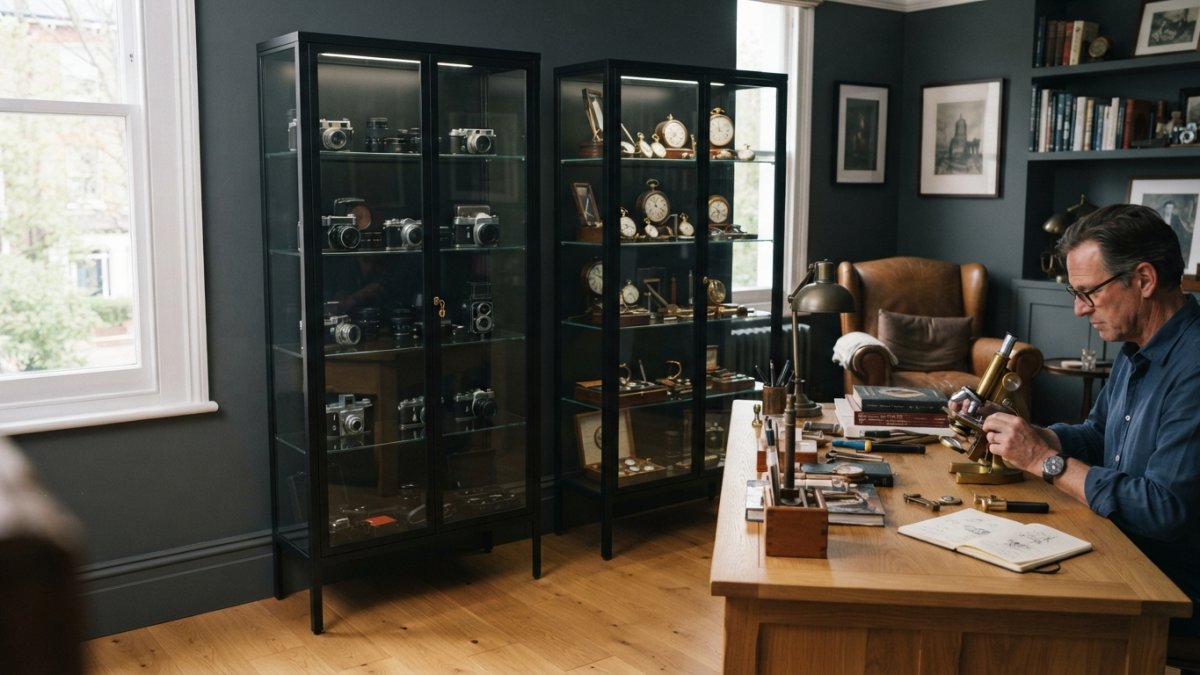
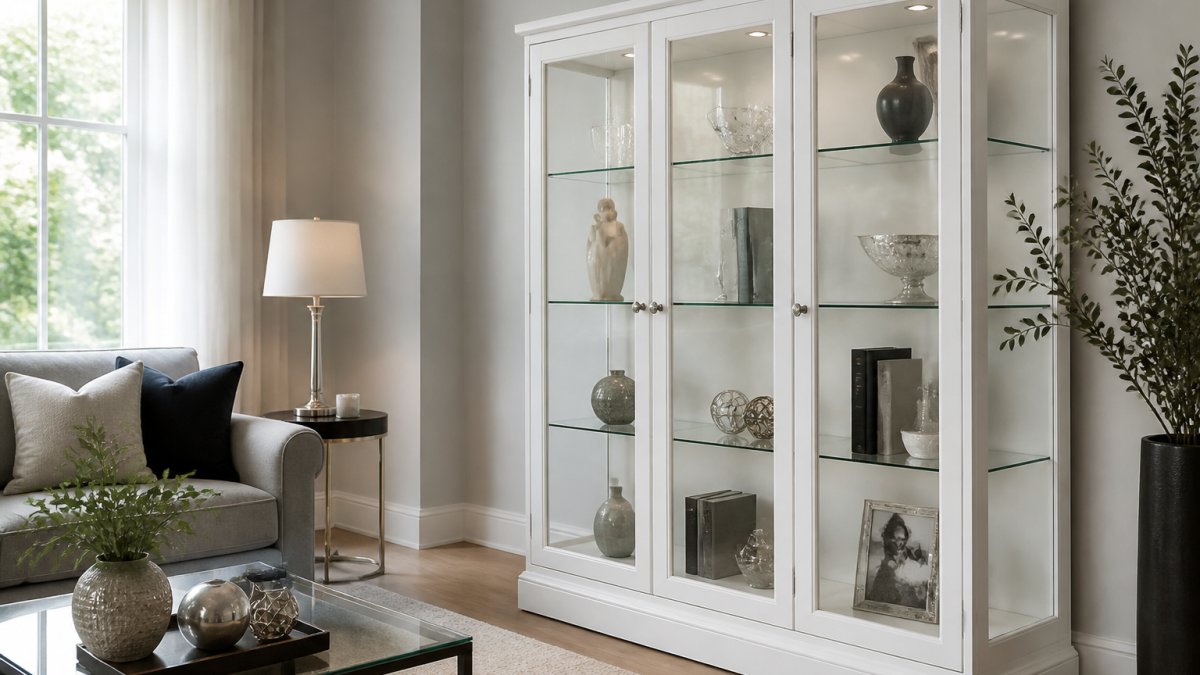
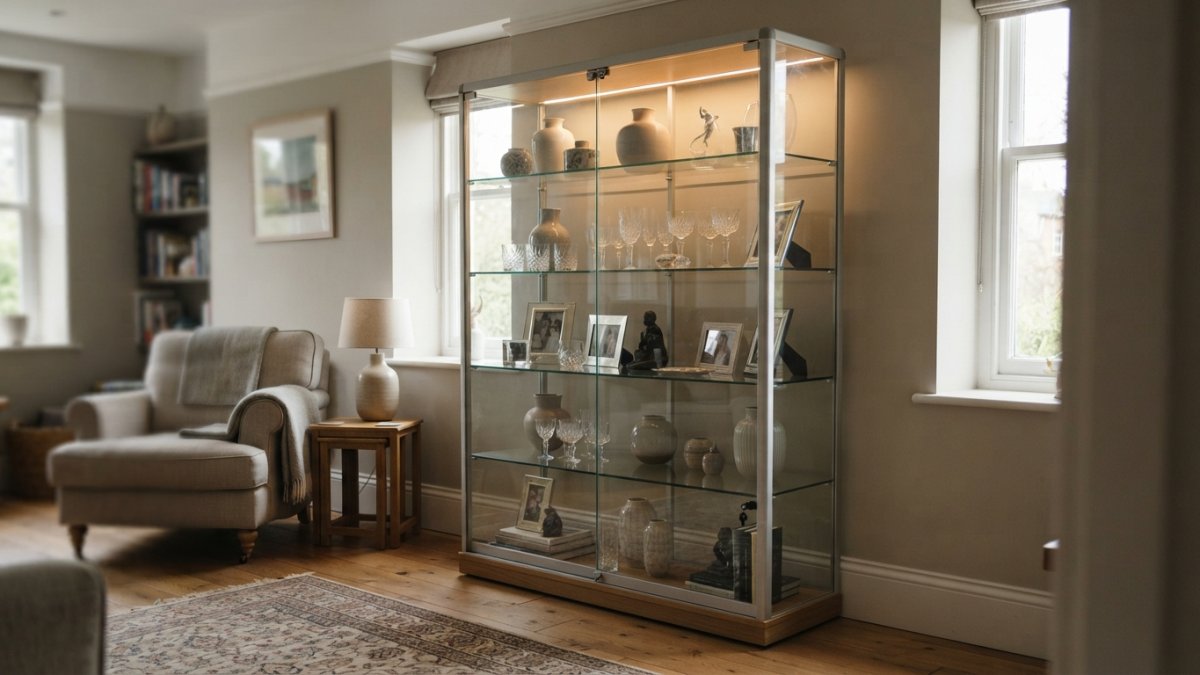
- Freestanding cabinets stand against a wall and suit living rooms and home offices; they are the most flexible option because you can reposition them.
- Corner cabinets reclaim dead space in smaller rooms, but check the door swing, because a corner position can restrict opening.
- Tall display cabinets give more shelf tiers in a smaller footprint, suiting collections that grow upward.
- Wall-mounted units free up floor space but need fixing into a solid wall, never plasterboard alone.
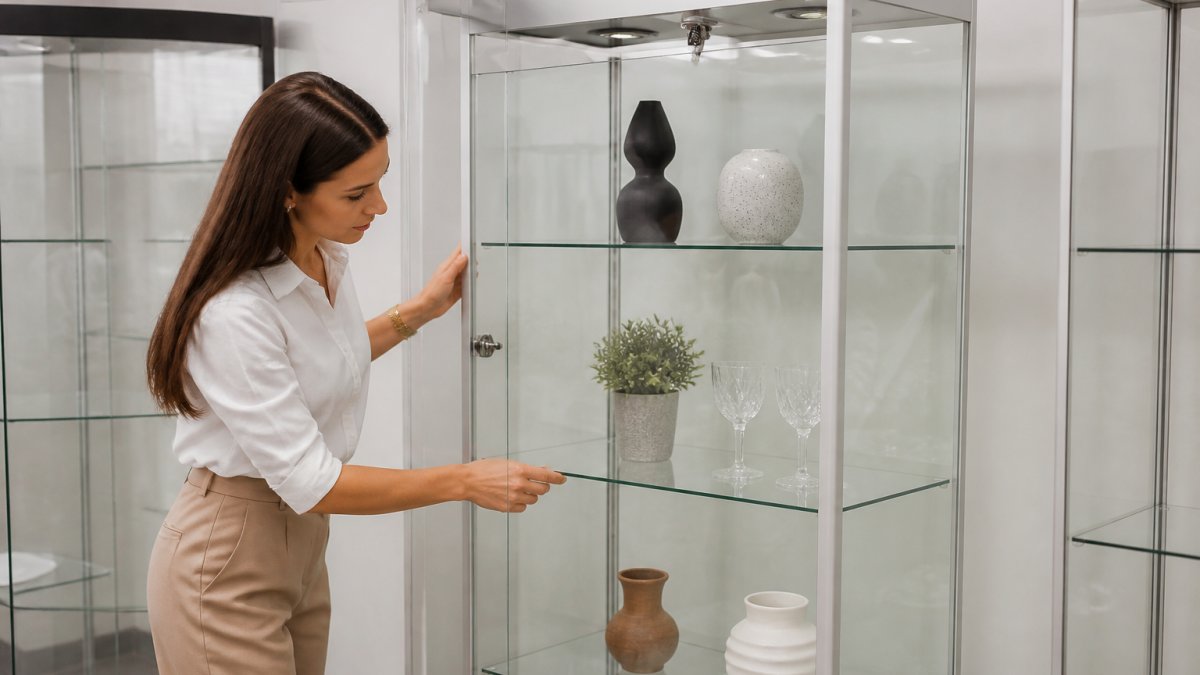
Door configuration matters as much as the frame. Single doors suit narrow spaces, double doors give wider access, and sliding doors save the clearance a hinged door needs.
Measuring height, width and depth before you buy
Measure the space, then measure the route to it. Doorways, stair turns and lifts catch out more buyers than room dimensions ever do.
- Confirm the full height including any cornice, and check ceiling height plus clearance to fit it upright.
- Allow for width plus the door swing or sliding clearance.
- Check depth against the room's traffic flow, and remember that a deep cabinet is harder to clean at the back.
If you are browsing options by style and size, you can browse glass display cabinets by style and door configuration to compare real dimensions before committing.
Glass Types, Frames, Finishes and Shelf Load Limits
Specification is where cheap cabinets reveal themselves. The glass type, frame material and shelf fixings decide how the cabinet performs over time, and, in the case of glass, how safely it fails if it ever does.
Tempered versus laminated glass: how each actually behaves
Tempered glass is heat-treated so the outer surfaces are in compression and the core is in tension, which makes it considerably more impact resistant than ordinary annealed glass of the same thickness.
Laminated glass is two or more panes bonded to a plastic interlayer, usually polyvinyl butyral (PVB).
Both are reasonable; untreated annealed glass in a large panel is not. If a product listing does not state the glass type, ask the supplier before buying.
Frame materials and what they mean for stability
Frame choice shapes the look and the durability, but it also determines how well the cabinet resists racking, the side-to-side twist that makes doors catch and shelves sit unevenly.
- Solid wood frames suit period and traditional interiors and can be refinished. Timber moves with humidity, so joints need to be glued and pinned rather than merely screwed; a mortise-and-tenon or dowelled joint resists racking far better than butt joints.
- Metal frames, usually steel or aluminium, are the most dimensionally stable and suit modern and retail settings. Powder-coated finishes in black, white or silver hide minor scuffs. Check that the frame is a welded or bolted box rather than a push-fit system, which loosens over time.
- Oak finish remains the most versatile for living rooms, but it can mean solid oak, oak veneer on a manufactured board, or a printed foil. Solid oak takes refinishing; veneer and foil do not.
A practical test: with the cabinet empty and the doors open, press gently on one top corner. A rigid frame moves as one unit; a flimsy one flexes and the doors drift out of alignment.
Shelf load limits and weight distribution
Shelf load limits deserve more attention than they get.
- Distribute heavy items across the shelf rather than clustering them at one end.
- Put the heaviest pieces on the lowest shelf tiers, where the load path to the base is shortest and the frame is stiffest.
- Keep a finger-width gap between the back of the shelf and the rear panel so air can move and the glass is not stressed against a fixing.
- If a shelf bows visibly under load, it is overloaded, full stop, remove weight before it fails.
Shelf load capacity depends on glass thickness, the frame and how the weight is distributed. If you are displaying heavy items, ask the supplier for the stated shelf load rating rather than guessing, and spread the weight across two shelves where you can.
For a deeper look at construction and material choices, our lockable display cabinet buying guide covers security, glass types, sizing and lighting in more detail.
How to Style a Display Cabinet Without Clutter
Styling a glass display cabinet is the practice of arranging objects in balanced groups with deliberate empty space, so the eye rests rather than scrambles. Curating these vignettes requires a disciplined approach to negative space that echoes the broader principles of styling luxury interiors, where the harmony of the entire room dictates the placement of every individual piece.
Check out →
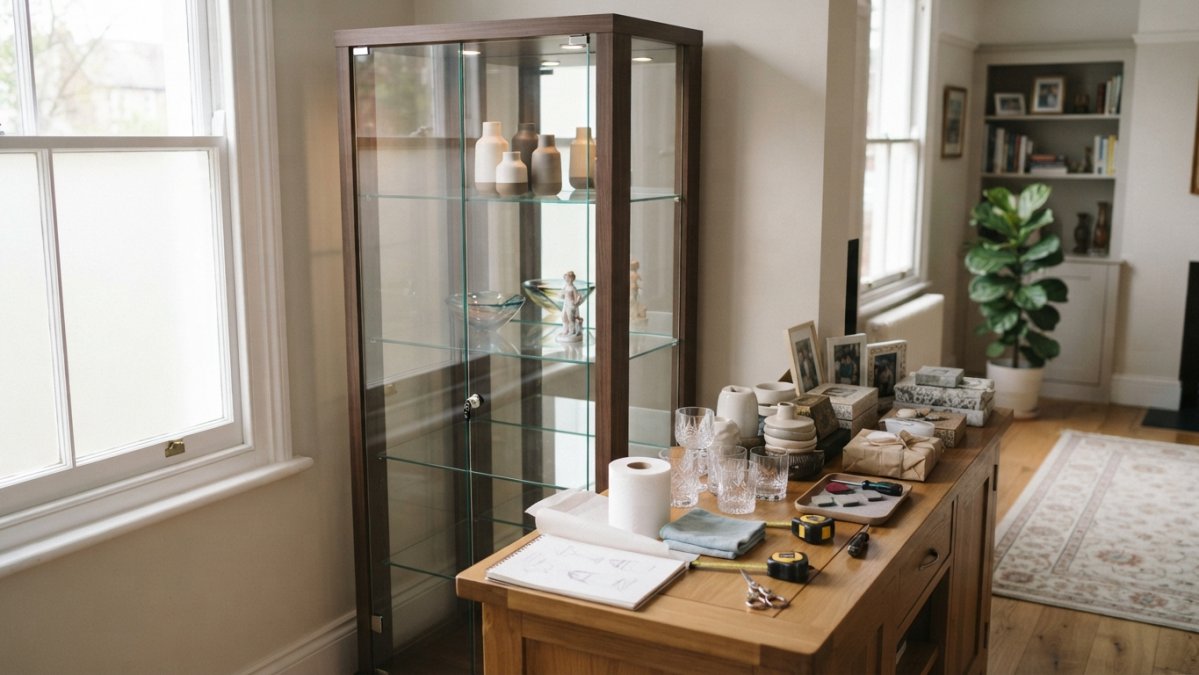
Work in odd-numbered groups of three or five, vary heights within each group, and leave roughly a third of each shelf empty. Resist using the cabinet as overflow storage, and rotate pieces seasonally rather than adding more.
A practical starting checklist:
- Group by material or colour, not by acquisition date
- Place the tallest piece at the back of each group
- Keep one shelf deliberately sparse as a visual breather
- Store anything you would not display elsewhere
Display Cabinet Lighting Ideas That Reduce Glare
Good display cabinet lighting ideas start with one rule: light the objects, not the glass. Glare comes from light bouncing off the front pane into the viewer's eye, and it is the fastest way to ruin an otherwise well-styled cabinet.
- Use warm-white LED strips rated for enclosed use, mounted at the front of each shelf and aimed back and down.
- Avoid single bright spotlights, which create hot spots and harsh shadows.
- Choose dimmable fittings so evening light does not overpower the room.
- Keep cables routed away from shelf edges and door hinges.
For more on LED options and glare control for home display, see our guide to glass cabinets with lights for home display.
Lockable Glass Display Cabinet Security and Anchoring
A lock only works if the cabinet cannot be walked away with. Security has two layers: the locking mechanism and the anchoring.
Choose a lockable glass display cabinet, and for high-value items consider one that can be anchored to the wall.
Watch out: an unanchored tall cabinet is a tipping risk as well as a theft risk, particularly in homes with children or large pets.
To act on this, you can view lockable glass display cabinet options with keyed locks built in.
Glass Display Cabinet Assembly, Cleaning and Long-Term Care
Most problems with glass display cabinet assembly trace back to one step: assembling it on a soft or uneven floor and forcing the frame square. Work on a flat, protected surface, keep fixings loose until the frame is square, then tighten gradually. That single discipline prevents the rattling doors and misaligned shelves that plague flatpack builds.
Safe assembly and glass handling
Glass panels are heavy, awkward and unforgiving of edge knocks. A few habits make the difference:
- Two people, gloves and eye protection. Carry panels upright, never flat, and never lift by the edge alone.
- Inspect before fitting. A chip or star crack at an edge is a stress riser; reject the panel rather than fitting it.
- Fit glass last. Build and square the frame first, then slide shelves and doors into place.
- Do not over-tighten shelf fixings. Pinch the glass, do not crush it; over-tightened clips are a common cause of later breakage.
Anchoring and load limits
- Fix tall units to a solid wall using appropriate brackets; never rely on plasterboard alone unless you have located and fixed into studs or used a rated cavity fixing.
- Anchor before loading, and load from the bottom up so the centre of gravity stays low.
- Check the wall anchor annually and re-tighten or replace if loose.
Cleaning routine that protects the finish
| Task | Frequency | Method |
|---|---|---|
| Dust shelves and glass | Weekly | Microfibre cloth, dry |
| Clean glass panels | Monthly | Non-ammonia glass cleaner, sprayed onto cloth not glass |
| Check shelf fixings and door hinges | Every 6 months | Tighten and inspect |
| Check wall anchors | Annually | Re-tighten, replace if loose |
Spray cleaner onto the cloth rather than directly onto the glass, so fluid cannot run down and pool in the fixings or frame joints. Avoid ammonia-based cleaners on laminated glass edges, and never spray directly onto fixings. For flatpack buyers, follow the supplied instructions in order; skipping the squaring step is the most common cause of rattling doors later.
For flatpack buyers comparing options, our guide to flatpack versus assembled display cabinets and how the assembly service works sets out what each involves before you order.
Ordering Your Cabinet With Delivery and a Build Service
Ordering comes down to one decision: flatpack or built. Flatpack suits confident DIYers with time and a second pair of hands.
Our cabinets are supplied as flatpack or with a build service, with free nationwide delivery.
At Display Cabinets UK, we supply premium glass display cabinets with locks and lights, flatpack or built by our team, with free nationwide delivery.
Frequently Asked Questions
What should I look for when buying a large glass display cabinet?
Check the cabinet dimensions against your room and doorway before ordering, and confirm the glass type: tempered or laminated glass holds together better if struck. Look at shelf count and adjustability, door style (single, double or sliding), and whether the frame is solid wood or a painted finish. For valuables, choose a lockable model. Also ask about assembly support and delivery, because a large cabinet is difficult to move once built.
How do you light a glass display cabinet without causing glare?
Aim any lighting down and slightly back so the light washes over objects rather than shining at the viewer. Avoid placing lights directly in front of glass doors. Dimmable options let you adjust for evening display. Keep cables tidy and check that any fitted lighting is low-voltage and suitable for enclosed furniture.
Are glass display cabinets safe for homes with children or pets?
Safety depends on glass type and anchoring. Glass type and wall anchoring both affect how safely a cabinet performs, so check the specification and fixing guidance supplied with your cabinet. Choose a lockable cabinet to keep doors closed, avoid placing heavy items on top, and site the cabinet away from busy walkways. Check shelf load limits and distribute weight evenly.
How difficult is glass display cabinet assembly and what support is available?
Flatpack assembly usually involves fixing the frame, fitting glass panels and shelves, and attaching doors, which two people can manage in an afternoon with basic tools. Instructions vary by model. If assembly is not for you, our build service is available. Ask the supplier what support they offer if a part is missing or damaged during setup.