 how-to
9 Things to Check Before Buying a Glass Display Cabinet
Last Updated: October 24, 2026
Quick Summary
A glass display cabinet from an online retailer is secure enough for everyday household risk if it has tempered glass, a working lock that secures all doors, and an anti-tip strap fixed to a solid wall. It deters children and pets but is not a safe against a determined thief.
- Check the listing says tempered or toughened glass, not just glass, and ask for door and shelf thickness.
- Confirm the lock is included in the price and secures every door, with spare keys supplied.
- Anchor the cabinet with an anti-tip strap to a solid wall fixing, matching the fixing to your wall type.
- Keep heavy items low and light items high, and stay within the published per-shelf weight limit.
- A cabinet deters and delays but does not resist a targeted break-in, so check your insurance for high-value items.
Table of Contents
- Are Glass Display Cabinets from Online Retailers Secure Enough?
- Why a Lockable Glass Display Cabinet Is the First Line of Defence
- Tempered Glass Display Cabinet: What the Specification Should Say
- How to Secure a Display Cabinet to the Wall
- Glass Cabinet Shelves Weight Limit: How Much Can You Actually Display?
- Child- and Pet-Proofing Checklist for Buying Online
- Where a Household Cabinet Stops: Realistic Security Limits
- Check Out Display Cabinets UK Before You Order
- Frequently Asked Questions
Are Glass Display Cabinets from Online Retailers Secure Enough?
A glass display cabinet is furniture with framed glass panels and doors, built to hold and show valuable items behind a physical barrier.
At Display Cabinets UK, we sell these cabinets flatpack and built. A well-specified cabinet with a working lock and a wall anchor handles normal household life; a cheap one with thin glass and a loose latch does not.
Below are the nine checks that separate the two, in the order we would run them.
Why a Lockable Glass Display Cabinet Is the First Line of Defence
A lock is the difference between a display and an open shelf, the feature that turns "look but don't touch" into a rule the cabinet enforces for you.
But a lock only works if the rest of the cabinet holds up. A good lock on a flimsy door is a padlock on a curtain.
Key Locks vs Electronic Locks
Key locks are standard for home cabinets: simple, powerless and unhackable, though one lost key means a locksmith or a replacement barrel. Electronic locks suit retail displays and shared homes, allowing codes, multiple users and audit trails, but they need batteries. For most homes, a key lock is the right call; for a small shop, an electronic lock earns its place.
What a Lock Will and Won't Stop
A cabinet lock stops opportunity, not determination.
- It will stop: a child opening the door, a guest lifting an item out, a pet nosing the glass open.
- It will not stop: a determined thief with tools, a forced door, or a lifted cabinet.
Treat a lock as a delay and a deterrent, and you will buy the right cabinet. Our lockable display cabinet buying guide covers security, glass types, sizing and lighting in more detail.
Tempered Glass Display Cabinet: What the Specification Should Say
A tempered glass display cabinet uses heat-treated glass that breaks into small blunt pieces rather than long shards, so if the glass goes, it is far less likely to cut someone.
Check the listing for "tempered" or "toughened". If the spec says only "glass", assume it is annealed and ask the seller directly.
The Health and Safety Executive guidance on glass and glazing is a useful reference for why glass type matters in the home, particularly where children are around.
Glass Thickness and Shatter Resistance
Thicker glass resists impact better, but tempering matters more than a millimetre of extra depth.
Ask the seller three questions before you buy:
- Is the glass tempered or toughened?
- What is the thickness of the doors and the shelves?
- Is there a safety film or backing option?
Vague answers tell you something about build quality too.
How to Secure a Display Cabinet to the Wall
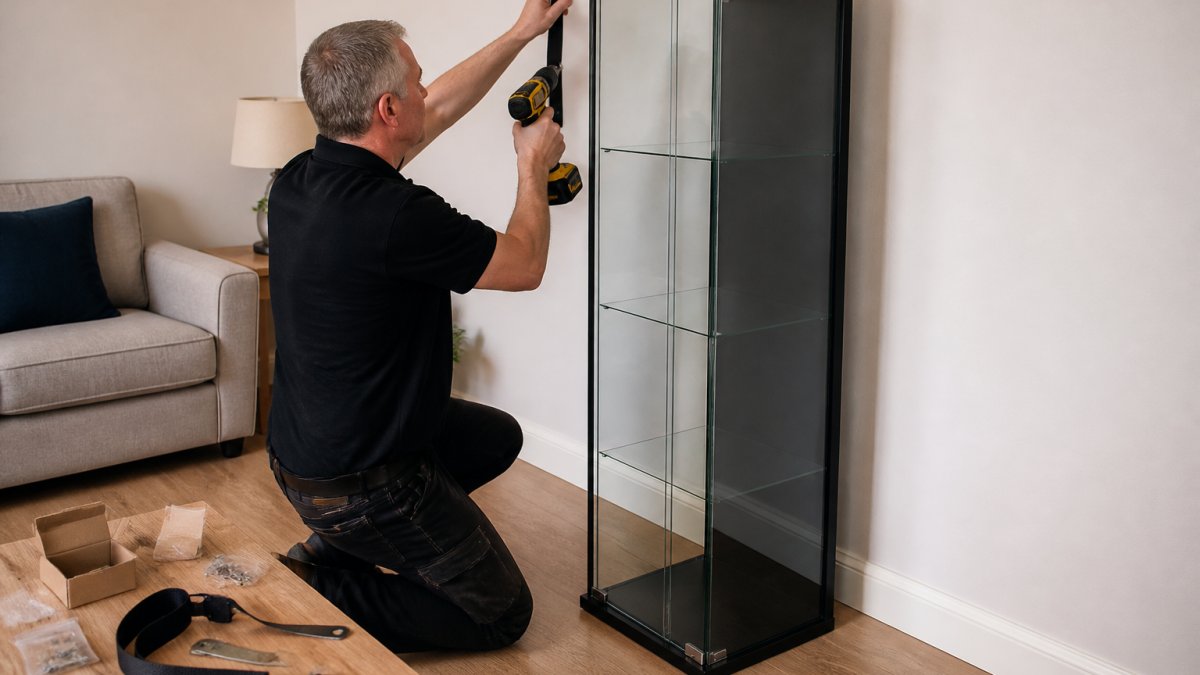
Securing a display cabinet to the wall means fixing an anti-tip strap or bracket from the top rear of the cabinet to a solid wall fixing.
This is the step most buyers skip, and it is the one that matters most. The Royal Society for the Prevention of Accidents advice on furniture safety is clear that anchoring tall furniture is a basic safety step, not an optional extra.
Assess the risk before you anchor
Not every cabinet carries the same tipping risk. Work through these questions before deciding how much anchoring effort is needed:
- Height and proportions: A cabinet taller than it is wide, or over about 1.2 m tall, is a higher tipping risk; a low, wide sideboard-style cabinet is inherently more stable.
- Door type and travel: Outward-opening doors shift the centre of gravity forward, and double doors shift it further. Sliding doors are less of a tipping risk than hinged ones.
- What goes inside: Keep heavy items low, light items high, and spread weight evenly.
Choose the right fixing for your wall
The strap is only as good as the fixing it goes into. Match the fixing to the wall type:
Check out →
- Solid masonry (brick, block, stone): Use a masonry plug and screw, or a concrete anchor. Drill to the plug's specified diameter and depth.
- Timber stud partition: Fix into a stud, not the plasterboard between studs. Use a stud finder to locate the centre, then a wood screw long enough to bite into the stud.
- Plasterboard without a stud: Use a heavy-duty plasterboard fixing rated for the load, or fit a timber batten across two studs and fix the strap to the batten. Plasterboard alone will not hold a loaded cabinet in a tip event.
If unsure, get a joiner to fit the anchor, the cost is small against the cost of a failed anchor.
Fit the anchor correctly
- Position the cabinet where it will live, allowing clearance for doors and access.
- Locate the anti-tip strap or bracket supplied. If none is supplied, buy a furniture wall strap rated for the cabinet's weight.
- Fix one end to the top rear, using the cabinet's own fixing points where provided. Do not drill into glass or a hollow panel section.
- Mark the wall fixing point, drill, and fit the appropriate plug or anchor.
- Fix the wall end and tighten so the strap is taut but not so tight that it pulls the cabinet out of level.
- Check the cabinet is level and stable, then load it from the bottom up.
Load and check after anchoring
Anchoring is not a one-off. After loading, open both doors fully and check the cabinet does not rock or lean. Re-check the fixings after the first week, after any move or redecoration, and whenever you add heavy items to the top shelves.
If you rent and cannot drill, choose a low, wide cabinet that is inherently stable, keep heavy items on the bottom shelf, and use a freestanding anti-tip brace where the design allows. Discuss any fixing with your landlord first.
Glass Cabinet Shelves Weight Limit: How Much Can You Actually Display?
Glass cabinet shelves weight limits depend on glass thickness, the span between supports and the shelf fixings. A short shelf with a centre support carries far more than a long unsupported span.
Most manufacturers publish a per-shelf limit. If yours does not, work on the cautious side and spread weight evenly.
- Keep heavy items low and light items high.
- Spread weight across the shelf, not in one corner.
- Check the shelf supports, not just the glass.
If you need more shelves or replacements, check our website for options.
Child- and Pet-Proofing Checklist for Buying Online
Most online listings give you enough information to judge a cabinet's child- and pet-resistance before you order, if you know where to look. This checklist turns each buying decision into a verifiable question for the seller or the specification. For more on comparing flatpack and pre-built models, locking options and lighting, read our guide to buying glass display cases online.
1. Glass type and thickness
- What to check: The listing should say "tempered" or "toughened" glass, not just "glass". Ask for door and shelf thickness in millimetres. A common domestic spec is 4-6 mm for doors and 5-8 mm for shelves, but the exact figure matters less than whether the seller will state it.
- Why it matters: Tempered glass breaks into small blunt pieces rather than long shards, the biggest safety difference where children and pets are concerned. If the seller cannot confirm tempering, assume annealed glass and walk away.
- What to ask: "Is the glass tempered or toughened, and what is the thickness of the doors and shelves?"
2. Lock design and inclusion
- What to check: Confirm the lock is included in the price, not an optional extra. Look for the lock type (key, cam lock, electronic) and whether a spare key is supplied. Check whether it secures both doors or only one.
- Why it matters: A lock that secures only one door of a double-door cabinet leaves the second free to open. A lock sold as an add-on often means the cabinet was not designed around security.
- What to ask: "Is the lock included, does it secure all doors, and are spare keys supplied?"
3. Anti-tip hardware
- What to check: The listing should state that an anti-tip strap or wall bracket is supplied. Check whether wall fixings are included or you need to supply your own.
- Why it matters: A tall glass cabinet is a tipping risk the moment a child climbs or a pet jumps against it. Anti-tip hardware is a basic safety item, not a premium feature.
- What to ask: "Is an anti-tip strap or wall bracket included, and are wall fixings supplied?"
4. Hinge and frame material
- What to check: Look for metal hinges rather than plastic. Check the frame material, steel, aluminium or solid timber outlasts particle board or thin MDF. Look at the door weight the hinges are rated for.
- Why it matters: Plastic hinges fatigue and crack, and a door that drops or swings open defeats the lock. A flimsy frame flexes, stressing the glass and lock alignment.
- What to ask: "Are the hinges metal, and what door weight are they rated for?"
5. Shelf weight limits
- What to check: The manufacturer should publish a per-shelf weight limit. If not, ask. Check whether shelves are adjustable and whether extra shelf supports are available.
- Why it matters: An overloaded glass shelf can fail suddenly. Knowing the limit lets you plan what goes where before loading.
- What to ask: "What is the per-shelf weight limit, and are replacement shelves available?"
6. Edge finish
- What to check: Polished or bevelled edges, not raw cut glass. Raw edges chip and are sharper if the glass breaks.
- Why it matters: Chipped edges are a cut hazard and a weak point that can propagate into a crack.
- What to ask: "Are the glass edges polished or bevelled?"
7. Assembly and instructions
- What to check: Downloadable assembly instructions before purchase, whether assembly requires two people, and what tools are needed.
- Why it matters: A cabinet assembled incorrectly is less stable and more likely to fail. Reading the instructions before buying tells you whether the build is within your capability.
- What to ask: "Can I download the assembly instructions before purchase?"
8. Delivery and returns
- What to check: A returns policy that covers damage in transit. Check the delivery method, kerbside, room of choice, or white-glove, and whether packaging protects glass adequately.
- Why it matters: Glass cabinets are vulnerable in transit. A clear returns policy means a damaged delivery is the seller's problem, not yours.
- What to ask: "What is the returns policy for transit damage, and how is the cabinet delivered?"
Here are the eight checks to run before ordering, each with the question to put to the seller.
| What to check | What to ask | Why it matters |
|---|---|---|
| Glass type and thickness | Is the glass tempered or toughened, and what is the thickness? | Tempered glass breaks into small blunt pieces, not long shards |
| Lock design and inclusion | Is the lock included, does it secure all doors, are spare keys supplied? | A lock on one door leaves the second free to open |
| Anti-tip hardware | Is an anti-tip strap or wall bracket included, and are fixings supplied? | A tall glass cabinet is a tipping risk when children climb |
| Hinge and frame material | Are the hinges metal, and what door weight are they rated for? | Plastic hinges fatigue and crack; a dropped door defeats the lock |
| Shelf weight limits | What is the per-shelf weight limit, and are replacement shelves available? | An overloaded glass shelf can fail suddenly |
| Edge finish | Are the glass edges polished or bevelled? | Raw edges chip and are sharper if the glass breaks |
| Assembly and instructions | Can I download the assembly instructions before purchase? | A cabinet assembled incorrectly is less stable and more likely to fail |
| Delivery and returns | What is the returns policy for transit damage, and how is it delivered? | Glass cabinets are vulnerable in transit |
Where a Household Cabinet Stops: Realistic Security Limits
A household display cabinet is not a safe. It deters, delays and protects against everyday risk, but it does not resist a targeted break-in.
For high-value items, be honest about the limits:
- Insurance: check whether your policy requires a rated safe above a certain value.
- Placement: keep the cabinet away from windows and out of easy reach of doors.
- Layering: a cabinet lock plus a room lock plus an alarm is a chain, not a single point.
If your collection is worth serious money, a cabinet is one layer, not the only one.
Check Out Display Cabinets UK Before You Order
Our cabinets ship flatpack with a full build service if you would rather not assemble. Delivery is free nationwide, check our website for delivery details before ordering.
Browse our lockable glass display cabinet range to compare sizes, locks and lighting.
Frequently Asked Questions
Are glass display cabinets safe around children and pets?
They can be, provided three things are in place: tempered safety glass rather than ordinary glass, a working lock on the doors, and the cabinet anchored to the wall with anti-tip hardware. A glass display cabinet that is free-standing and unlocked is the main risk, because a toddler pulling on an open door or a cat jumping at the shelves can bring the whole unit forward. Anchoring is the single most important step and takes under half an hour.
Do glass display cabinets from online retailers come with locks?
Many do, but not all, and the type varies. Check the product specification for a key lock or electronic lock before ordering, and confirm whether the lock secures both doors or only one. A lockable glass display cabinet is only useful if the lock is fitted to the doors you actually open. If the listing is vague, ask the retailer directly for the lock type and whether replacement keys are available.
How do you stop a display cabinet from tipping over?
Use the anti-tip strap or bracket supplied with the cabinet, or buy one if it is not included, and fix it from the top rear of the unit into a solid wall or a stud. Never rely on the cabinet's own weight, especially on carpet. Keep the heaviest items on the bottom shelf and avoid stacking weight on the top. If you use the brand's build service, ask them to anchor it as part of installation.
Are glass shelves strong enough for heavy collectables?
It depends on the glass thickness and the shelf supports, so check the stated glass cabinet shelves weight limit rather than guessing. Tempered glass shelves at 6mm or more, properly supported at both ends, handle typical glassware and memorabilia comfortably. Distribute weight evenly, keep the heaviest pieces low, and never exceed the figure the retailer quotes. If no weight limit is published, ask before you buy.
The gap between a cabinet that protects your collection and one that merely holds it comes down to a handful of specifications. Check the glass type, confirm the lock, anchor it to the wall, and know the shelf limits. Get those right and a display cabinet does its job quietly for years.
Get started with Display Cabinets UK and choose a cabinet built to keep your valuables safe from curious hands and paws.