 how-to
How to Secure Glass Cabinet Locks: A Step-by-Step Guide
Table of Contents
- Glass Cabinet Locks: What You Need Before You Start
- Sliding Glass Cabinet Door Lock Options
- How to Add a Lock to a Cabinet: Step-by-Step
- Cabinet Locks for Glass Doors: Cam, Clamp-On and Magnetic
- Keyed Alike Cabinet Locks for Multi-Door Units
- Security Limits, Child Safety and Access Control
- Troubleshooting and Maintenance
- Conclusion
- Frequently Asked Questions
Last Updated: October 13, 2026
Glass Cabinet Locks: What You Need Before You Start
A glass cabinet lock is a small locking mechanism fitted to a glass display cabinet to stop unauthorised access to the items inside.
Glass does not forgive mistakes. A drill bit that bites too fast, a clamp screwed down too hard, or a hole drilled too close to the edge can crack a panel that costs more to replace than the lock itself.
Tools and Hardware Checklist
Gather everything before you touch the cabinet. Stopping mid-job to hunt for a tool is how people rush and slip.
- Tape measure and a fine pencil
- Masking tape or low-tack painter's tape
- Centre punch or an awl
If your cabinet is a flatpack unit, check the fittings bag first. Many kits ship with a cam lock already sized for the door thickness.
Glass Safety and Drilling Risks
Tempered glass is strong across its face but fragile at the edges. Drilling within roughly 25mm of an edge or corner concentrates stress and causes cracks, the single biggest cause of broken panels during lock fitting. Heat from a fast drill weakens the glass, and over-tightened clamps chip it. If unsure, a clamp-on or adhesive lock avoids the drill entirely.
Sliding Glass Cabinet Door Lock Options
Sliding doors have no swinging edge to mount a cam lock into, so the lock must block the sliding track or clamp the two panels together. The most common sliding glass cabinet door lock is a ratchet bar, which sits between the panels and locks them so neither can move. Fitting takes minutes and needs no drilling. Your main options:
- Ratchet bar lock: wedges between overlapping panels, adjustable to the gap
- Track block: a metal pin that drops into the runner channel
- Clamp-on sliding lock: grips the inner frame of both panels
For display cases with a single sliding panel, a track block is the neatest choice. It is discreet and does not touch the glass face.
How to Add a Lock to a Cabinet: Step-by-Step
This is the core process for a cam lock on a hinged glass door with a frame or metal edge. Budget 30 to 45 minutes for your first one.
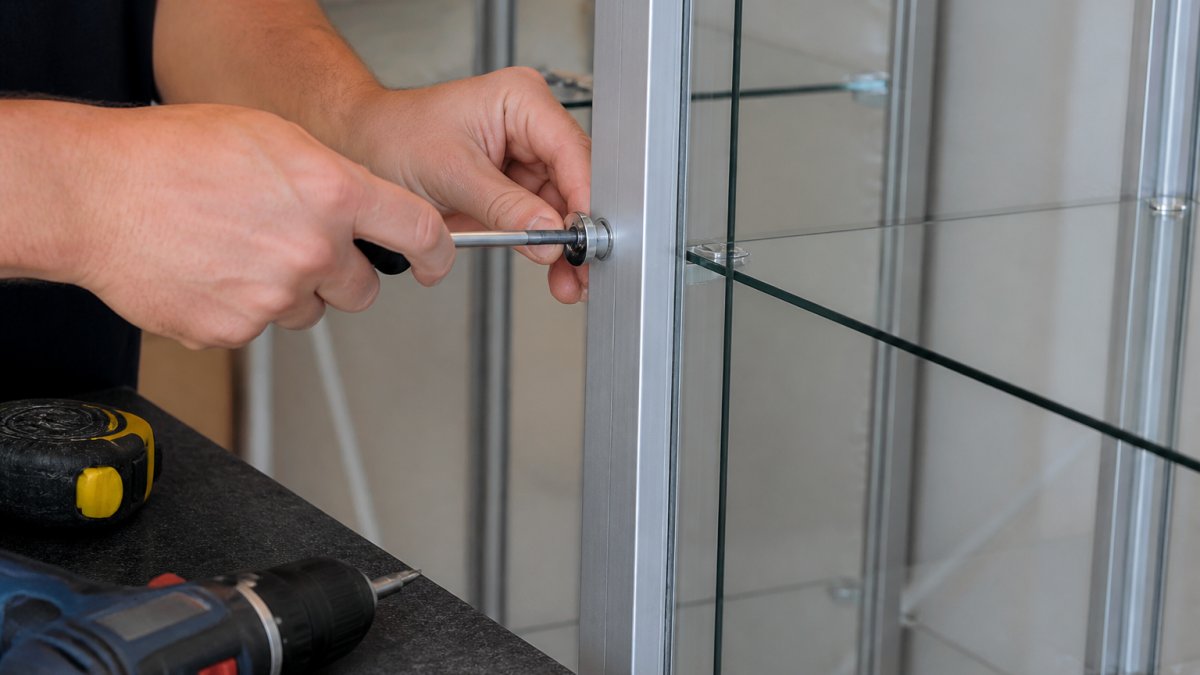
Measure Before You Mark
Three measurements decide whether the lock will fit. Take all three before you touch a drill.
- Glass thickness. Measure the panel in millimetres to confirm the lock body and any spacers are sized correctly.
- Frame depth. Measure from the outer face of the frame to the inner face. The barrel must be long enough for the cam to clear the inside face by a few millimetres, but not protrude awkwardly outside.
- Door overlap. Close the door and measure how far the opening edge overlaps the fixed frame or other leaf. A cam that lands short will not hold; one that lands past it will not close.
Write the figures down. When ordering, match barrel length to frame depth and cam reach to the overlap.
Mark the Lock Position
Position the lock on the frame, not the glass, wherever the cabinet has a frame. If your cabinet is all-glass with a metal edge, mount into the metal.
- Close the door and check the alignment of the opening edge.
- Mark the lock centre roughly 150mm to 200mm down from the top edge, clear of the door pull.
- Keep the hole at least 25mm from any frame edge or corner, where stress concentrates and cracks start.
- Check the barrel length against the frame depth again, the cam needs to clear the inside face by a few millimetres.
- Place masking tape over the mark and mark the centre on the tape, not the glass or finished frame.
- Use the centre punch to make a small start point so the bit does not wander.
Drill and Fit the Lock Body
Drill slowly. Let the bit do the work and keep the speed low.
- Start the hole at the punch mark, holding the drill straight and square to the frame.
- Apply light, even pressure. Add a drop of water to keep the bit cool if drilling metal.
- Drill through in one pass, a partial hole is where bits snag.
- Insert the lock body and check the fit; it should sit flush with no wobble.
- Fit the cam to the rear of the barrel and secure the retaining nut.
- Close the door and turn the key. The cam should catch the frame cleanly.
- Adjust the cam position if the door does not sit flush.
Post-Installation Checks
Run through these before you call the job done, they catch problems that show up a week later.
- Key turns smoothly through a full quarter turn with no grinding.
- Door holds shut with no play in the barrel and no rattle.
- Cam catches the frame across the full overlap, not just at the tip.
If any check fails, loosen the retaining nut and adjust the cam before tightening again.
Cabinet Locks for Glass Doors: Cam, Clamp-On and Magnetic
Cabinet locks for glass doors fall into four practical families. The right one depends on how the door moves, whether the panel is framed or frameless, and whether you are willing to drill. Use the table as a starting point, the deciding factor is usually the glass itself.
| Lock Type | Best For | Drilling Needed | Typical Security Level |
|---|---|---|---|
| Cam lock | Hinged doors with a frame or metal edge | Yes (frame or metal, not glass) | Medium |
| Clamp-on lock | Frameless glass panels, hinged or sliding | No | Low to medium |
| Magnetic lock | Discreet display cases, low-traffic areas | Sometimes | Low |
| Ratchet bar / track block | Sliding doors | No | Medium |
Match the Lock to the Cabinet Configuration
Work through these questions in order, the first "no" usually rules out a whole family of locks.
- Does the door slide or swing? Sliding doors have no swinging edge for a cam lock to bite into, go to a ratchet bar, track block or clamp-on sliding lock. Hinged doors can take a cam lock, clamp-on or magnetic catch.
- Is there a frame or metal edge? If yes, mount the lock body into the frame or metal, never the glass. Frameless panels are limited to clamp-on, magnetic or adhesive options.
- One door or a pair? Paired doors need a lock on each leaf or a single lock plus a fixed leaf. A ratchet bar across the overlap is simplest.
Identify Your Glass Before You Choose
Most display cabinet panels are tempered (toughened) glass. It is roughly four to five times stronger than annealed glass across its face, but fragile at the edges and cannot be drilled, cut or ground after tempering without shattering into small blunt fragments. Drill tempered glass and you get a broken panel, not a clean hole. Maintaining the structural integrity of the entire unit remains vital, especially when you need to fix loose cabinet hinges to ensure the doors align perfectly with the glass panels.
Signs to tell the difference:
- A kitemark or BS marking etched near a corner. Toughened glass sold in the UK is normally marked to BS EN 12150.
- The edge. Tempered panels usually have smooth, rounded or polished edges; annealed glass is sharper and rougher.
- The break pattern. Tempered glass breaks into small granular pieces; annealed glass into long jagged shards.
If your panel is tempered, do not drill it. Choose a clamp-on, magnetic or ratchet-bar lock instead. If you genuinely need a drilled cam lock, the hole must go into a frame or metal edge, not the glass.
Check out →
The Four Lock Families in Practice
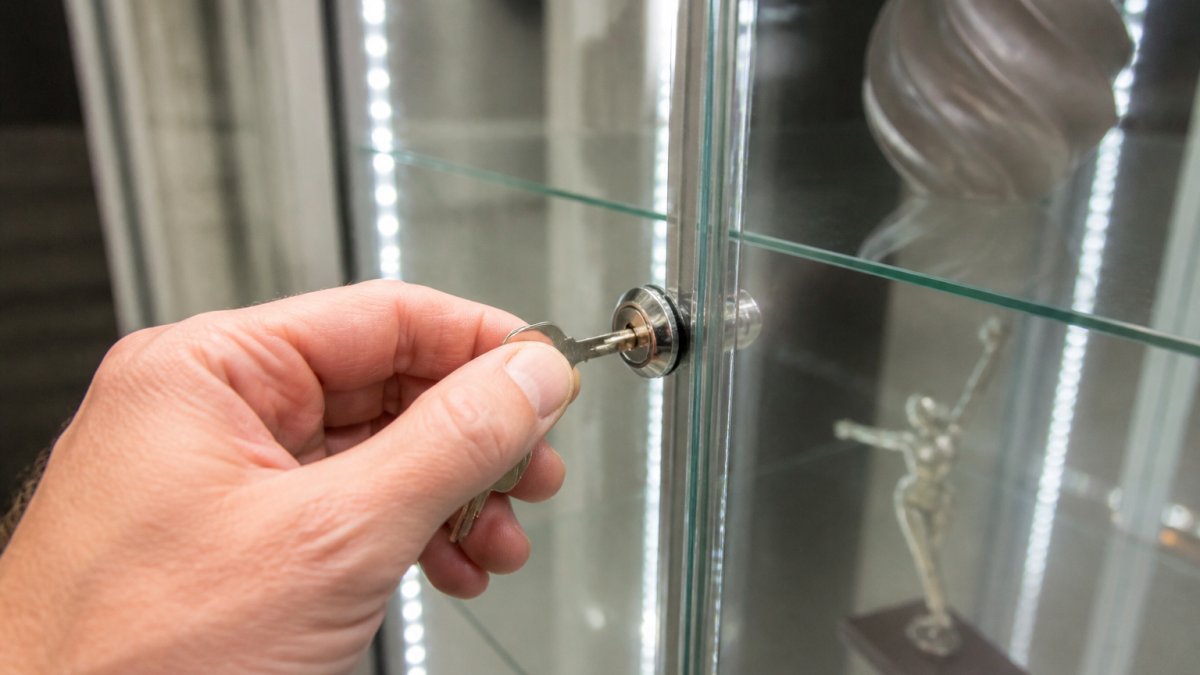
Cam locks are the standard choice for hinged doors with a frame.
Clamp-on locks grip the edge of a glass panel with a metal jaw and padded contact point.
Magnetic locks use a magnet to release a catch.
Ratchet bar and track block locks are the sliding-door options. A ratchet bar wedges between overlapping panels; a track block drops a pin into the runner channel.
If your cabinet has a metal frame, always drill the frame rather than the glass. It is stronger, safer and the hole is far easier to get right. If the frame is wood, the same applies, wood is forgiving, glass is not.
Keyed Alike Cabinet Locks for Multi-Door Units
Keyed alike cabinet locks let one key open every door in a unit, a real convenience for a retail display or a collector's cabinet with several sections. Order them as a set, not individually, so the supplier cuts every barrel to the same key profile; mixing locks bought at different times usually means different keys.
Where keyed alike matters most:
- Retail showcases with multiple bays
- Wall units with several glass doors
- Any cabinet where staff need quick access
One limitation: lose the single key and you lose access to everything at once. Keep a spare somewhere secure.
Security Limits, Child Safety and Access Control
Be clear about what a cabinet lock does and does not do. A cam lock or clamp-on fitting stops casual access, not a determined break-in, if you display high-value items, treat the lock as one layer, not the whole defence.
For child safety, choose a lock with a key or magnetic release that small hands cannot work, and avoid simple catches a child can flick open.
A cabinet lock is an access-control measure, not a vault. Match the lock to the threat and add alarms or CCTV for anything genuinely valuable.
Troubleshooting and Maintenance
Most lock problems trace back to fit, not the lock itself.
- Key turns but the door will not open: the cam is not catching the frame. Loosen the retaining nut and rotate the cam slightly.
- Door rattles when locked: the cam is too loose. Tighten it a quarter turn.
- Key sticks: use a dry graphite lock lubricant, never oil, which attracts dust.
Check your locks twice a year, a quick spray of graphite and a turn of the key keeps them working for years.
Conclusion
Fitting glass cabinet locks is a job most people can do in an afternoon, provided they respect the glass and measure twice.
At Display Cabinets UK, we supply premium glass display cabinets with locks and lights, available as flatpack or with our build service.
Check out our range of lockable glass display cabinets and find the right unit for your collection or shop.
Frequently Asked Questions
Can you fit a lock to a glass display cabinet without drilling?
Yes. Clamp-on locks, adhesive magnetic locks and ratchet-bar locks all secure glass cabinet doors without drilling. Clamp-on locks grip the door edge or frame, while adhesive locks stick directly to the glass. These options suit renters or anyone worried about cracking a glass panel. They are usually less secure than a drilled cam lock, so use them for deterring casual access rather than stopping a determined break-in.
What type of lock works on glass cabinet doors?
Cam locks are the most common for hinged glass doors, but they need a drilled hole in the frame or a metal plate. Clamp-on locks and sliding locks work well on overlapping sliding doors without any drilling. Magnetic locks suit frameless glass and child-safety setups. Keyed alike cabinet locks let one key open several cabinets, which is useful for retail displays or collectors with multiple units.
Can a lock be fitted to a cabinet with two glass doors?
Yes. For double doors, a central cam lock or a ratchet bar across both handles secures them together. If the doors overlap, a sliding glass cabinet door lock or clamp-on lock on the inner panel stops them parting. Check door alignment first; if the panels do not sit flush, the lock may not engage properly. Adjust hinges or runners before fitting.
How do you secure a glass cabinet without drilling?
Use clamp-on locks that grip the door edge, adhesive magnetic locks that stick to the glass, or a ratchet bar that spans the door pulls. These avoid drill holes and reduce the risk of cracking tempered glass. They suit rented homes, child safety and low-risk display protection. For high-value items, pair a no-drill lock with a cabinet alarm or place the unit in a locked room.