 ultimate-guide
Glass Cabinet Assembly Service Cost: UK Guide 2026
Table of Contents
- Glass Cabinet Assembly Service Cost: What You Are Actually Paying For
- Flat Pack Furniture Assembly Rates UK: Hourly vs Fixed-Price Models
- How Long Does It Take to Assemble a Glass Display Cabinet?
- DIY vs Professional Assembly for Glass Cabinets: Risks and Trade-Offs
- Hidden Costs and Warranty Implications of Glass Cabinet Assembly
- Glass Cabinet Assembly Service Cost: How to Prepare and Vet a Provider
- Frequently Asked Questions
Last Updated: October 4, 2026
Glass Cabinet Assembly Service Cost: What You Are Actually Paying For
Glass cabinet assembly service cost is the total amount a professional charges to build and install a flat-pack glass display cabinet, covering labour, tools, travel and disposal of packaging.
Here is the part most buyers miss: the price you are quoted rarely reflects the cabinet. It reflects the risk the assembler is taking on.
Glass is the reason. That is why a glass display cabinet costs more to assemble than a similarly sized wooden wardrobe, and why the cheapest quote is often the one that has not accounted for anything going wrong.
Below, we break down what drives the number, how hourly and fixed-price models compare, and how to vet a provider before you book.
Flat Pack Furniture Assembly Rates UK: Hourly vs Fixed-Price Models
Flat pack furniture assembly rates in the UK generally fall into two structures: an hourly rate charged for time on site, or a fixed price agreed before work starts. Platforms such as TaskRabbit's UK furniture assembly listings publish hourly rates per individual worker, while quote-based directories like Checkatrade's guide to hiring tradespeople put the price on the professional to assess and confirm.
| Model | How You Pay | Best For | Main Risk |
|---|---|---|---|
| Hourly rate | Per hour, plus call-out fee | Small, simple units | Bill grows if the job runs long |
| Fixed-price quote | One agreed figure | Glass cabinets, complex builds | Higher headline number |
| Bid-based marketplace | You accept a worker's bid | Budget flexibility | Quality varies by worker |
| Specialist supplier build | Bundled with the cabinet | Locks, lights, glass alignment | Requires buying from that supplier |
When an Hourly Rate Works Against You
An hourly arrangement rewards speed, not care. If a job overruns because a hinge needs resetting or a glass door needs realigning, you absorb that cost. For a straightforward unit, that rarely matters. For a glass display cabinet with integrated lighting and a locking mechanism, it can.
What a Fixed-Price Quote Should Include
A properly costed fixed-price quote should state the assembly labour, any call-out fee, packaging removal, and whether the price is VAT inclusive. Ask specifically about the last one. A quote that looks cheaper before VAT is often the more expensive option once it is added.
How Long Does It Take to Assemble a Glass Display Cabinet?
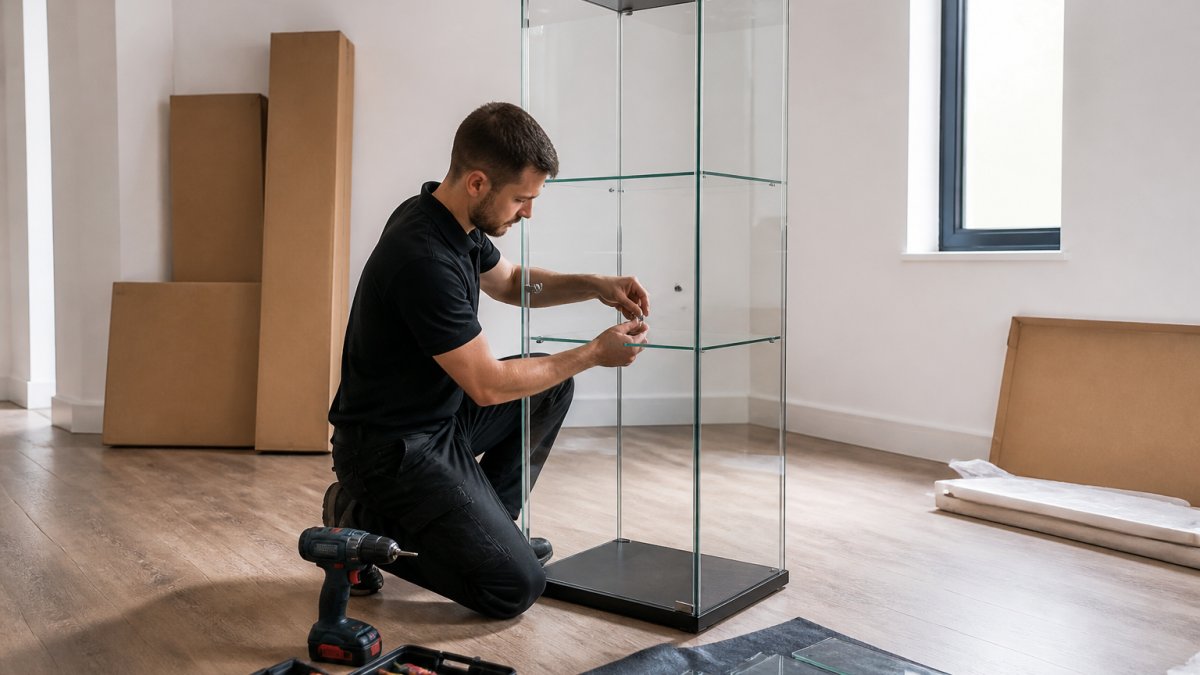
Most glass display cabinets take between one and three hours to assemble, depending on size, glass panel count and whether lighting or locking hardware is fitted.
Assembly time estimate drives cost directly under an hourly model. Under a fixed-price model it drives the quote. Either way, the variables are the same:
- Number of glass panels and how they are secured
- Whether doors need hinge adjustment after fitting
- Whether lighting requires wiring or runs from a plug
- Whether the unit must be anchored to the wall
- Access to the room, including stairs and door widths
Wall anchoring adds time but is not optional for tall units. A freestanding glass cabinet that could tip is a hazard, particularly in a home with children or in a retail space with foot traffic.
DIY vs Professional Assembly for Glass Cabinets: Risks and Trade-Offs
Most guides frame this as a simple skill-versus-cost decision. That framing misses the point with glass. The real question is whether the finished cabinet is structurally safe to load, and whether you can prove who is responsible if it is not. Those two questions are where DIY and professional assembly genuinely diverge.
The Safety Case Against DIY on Tall Units
A glass display cabinet is top-heavy by design. The glass doors, the shelving and whatever you put inside sit above a relatively light frame, which is why furniture-tipping injuries are a recognised household hazard and why tall storage units are expected to be anchored to a wall rather than left freestanding.
Anchoring is also the step most often omitted in DIY builds, because it requires drilling into the wall, choosing the right fixing for the substrate (plasterboard, brick, or a stud), and accepting that the cabinet's position is now fixed.
Weight Distribution and Shelf Loading
Glass shelves fail at the edges and at the point where the shelf meets its support, not in the middle. A shelf that is overloaded at one end, or that sits on a support that has been fitted upside down or at the wrong height, concentrates stress at a single contact point.
A competent assembler checks three things before the cabinet is loaded: that each shelf sits fully on its supports, that the supports are at matching heights, and that the load is spread evenly rather than stacked at one end.
Where Professional Assembly Earns Its Fee
A professional brings the tools, the second pair of hands and the insurance. More importantly, they bring judgement about structural stability: whether a shelf span needs a support, whether a door needs packing, whether the unit should be anchored rather than left freestanding, and whether the wall can take the fixing. For a cabinet holding valuable collectibles or retail stock, that judgement is the product.
Check out →
What DIY Assembly Actually Demands
DIY assembly is viable for a small, single-pane cabinet with clear instructions and standard hardware. If you take that route, you need a second pair of hands for anything with large glass panels, a spirit level, the correct screwdriver heads, a wall-fixing kit matched to your wall type, and floor space to lay components flat. Build on a blanket or cardboard, never directly on tiles or hardwood, edge contact is where most DIY glass damage happens.
Post-Assembly Checks and Maintenance
The job does not end when the last screw is in. Run a short check before the cabinet goes into service, and repeat it after three to six months, when hinges settle and fixings work loose:
- Open and close each door through its full arc and confirm the hinges hold the door without sagging
- Check every shelf support is still seated and at matching height
- Re-tighten hinge screws and any cam fixings, which commonly loosen in the first months
- Confirm the wall anchor is still firm and has not pulled away from the wall
- Check any integrated lighting cable is not pinched behind a panel or under a shelf edge
That three-to-six-month check is the step almost no guide mentions, and it is the one that catches the slow failures, a hinge working loose, an anchor easing out of plasterboard, before they become a broken pane.
Hidden Costs and Warranty Implications of Glass Cabinet Assembly
The quoted price is rarely the final cost, and the gap between the two is where most disputes start. Below is the itemised list of charges that sit outside a headline figure, followed by what professional assembly actually does to your legal position if something goes wrong. Clarifying these responsibilities early prevents ambiguity, particularly when hiring professional furniture assembly in Coventry to ensure that the installation process remains fully compliant with consumer protection standards.
The Surcharges That Sit Outside the Quote
- Call-out fee. Many hourly providers charge a fixed attendance fee before any work begins. Ask whether it is waived if the job is cancelled within a set window.
- Parking and access. In dense urban areas, parking permits, pay-by-phone parking or congestion charges may be passed to you. Confirm who pays before the van arrives.
- Congestion and clean-air zone charges. If the assembler must drive through a charging zone to reach you, that cost frequently appears as a line item. Ask directly.
- Packaging disposal. Removing cardboard, polystyrene and pallet wrap is often quoted separately. If you want it taken away, get it priced in writing.
- Wall anchoring hardware. The fixings themselves are cheap; the labour to drill and anchor is not. Confirm whether anchoring is included or billed as an extra.
How Assembly Affects Your Rights
Under the Consumer Rights Act 2015, goods you buy from a trader must be of satisfactory quality, fit for purpose, and as described. That protection covers faults in the product itself.
Professional assembly changes that picture. If a professional assembles the unit and damages it, the claim sits with them and their insurance, not with you. You are buying a clear line of responsibility, and on a high-value cabinet that line is often worth more than the assembly fee itself.
What to Confirm Before You Book
- Who is insured for damage to glass and to your property, and can they evidence it?
- Is the price fixed and VAT inclusive, in writing?
- Is packaging disposal included or extra?
- Is wall anchoring included, and are the fixings rated for your wall type?
- What happens if a pane cracks during assembly, who pays for the replacement?
- Does the supplier's own warranty remain valid if a third party assembles the unit?
That last question matters most. Some manufacturers require assembly by an approved fitter to keep the warranty intact, and a third-party build can void it. If you are buying a cabinet with integrated lighting or a locking mechanism, check the warranty terms before you book anyone, because the cheapest assembly quote can cost you the warranty on the cabinet itself.
Glass Cabinet Assembly Service Cost: How to Prepare and Vet a Provider
Preparation cuts cost more than negotiation does. Clear the room before the assembler arrives, confirm the delivery has been checked for damage, and have the instruction manual and hardware bag ready.
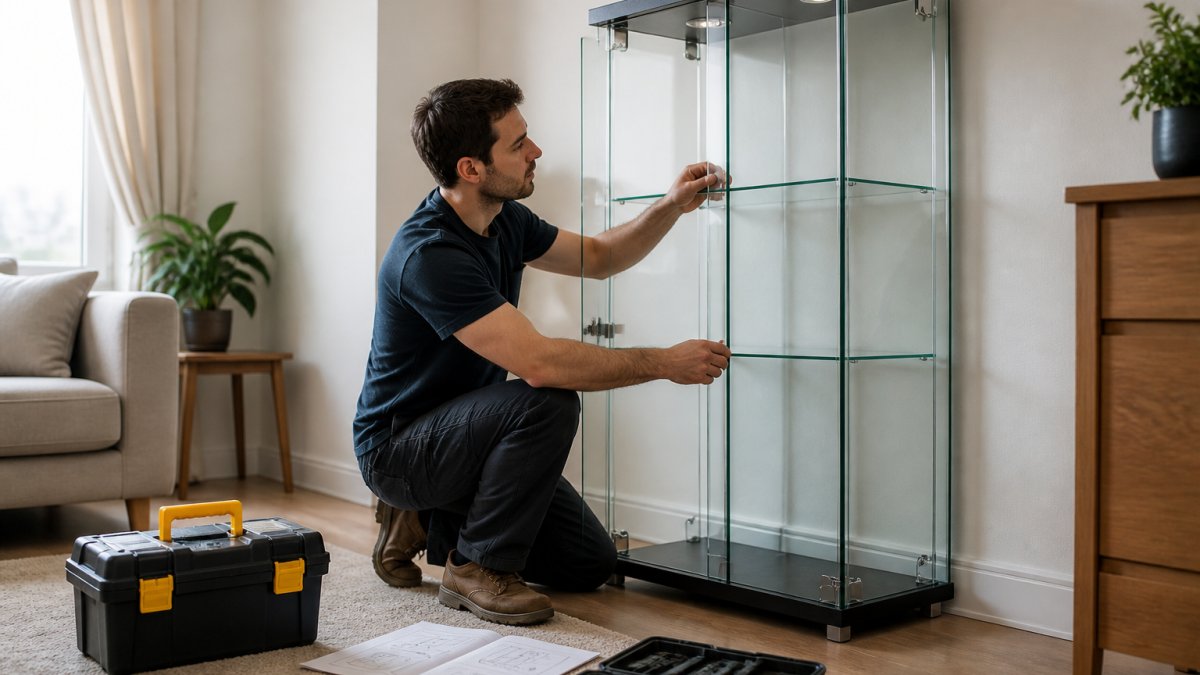
Vetting a provider comes down to four questions:
- Are they insured for damage to glass and to your property?
- Will they confirm a fixed price in writing, VAT inclusive?
- Do they have experience with locking and illuminated units specifically?
- What happens if a pane cracks during assembly?
The last question separates specialists from general handymen. A supplier who builds their own cabinets, as we do at Display Cabinets UK, knows how each unit goes together and carries the responsibility for getting it right.
Frequently Asked Questions
How much should you pay someone to assemble a glass display cabinet?
Assembly pricing depends on the cabinet's complexity, glass panel count, and whether wall anchoring or lighting installation is required. Specialist suppliers often quote per project. Always request a fixed-price quote that confirms whether VAT is included, and check whether packaging disposal and call-out fees are separate. For a glass cabinet, the lowest hourly rate rarely delivers the best result.
Does the complexity of a glass cabinet affect glass cabinet assembly service cost?
Yes. A single-door cabinet with tempered glass shelves takes far less time than a multi-panel unit with integrated locks, LED lighting, and adjustable hinges. Each glass panel must be handled individually, and hinge adjustment alone can add significant time. Cabinets requiring wall anchoring for structural stability also need extra labour. Ask your provider to confirm the assembly time estimate in writing before booking.
Is it cheaper to buy pre-assembled glass cabinets or pay for assembly?
It depends on the cabinet and your circumstances. Pre-assembled units avoid labour costs but often cost more upfront and carry delivery restrictions for large glass items. Flat-pack plus professional assembly can work out cheaper overall, especially when the supplier offers a build service as part of the purchase. Compare the total cost: cabinet price, delivery, assembly labour, and any packaging disposal fees.
Are there hidden costs when hiring a furniture assembly service?
Common extras include call-out fees, VAT not included in the quoted rate, packaging disposal charges, and surcharges for wall anchoring or lighting wiring. Some providers also charge more if the cabinet arrives damaged or with missing hardware, adding time to the job. Ask for a written breakdown covering labour, materials, and disposal before you confirm the booking, and check what the service guarantee covers.
Glass cabinet assembly is one of those jobs where the cheapest quote and the best value are rarely the same number. If you are weighing up whether to build it yourself or have it done properly, we supply premium glass display cabinets with locks and lights, offer a build service, and deliver free nationwide. Check out our range and build options to see what fits your space.