 listicle
7 Best Glass Display Cabinets for Jewelry: 2026 Guide
Table of Contents
- Comparison Table: 7 Best Glass Display Cabinets for Jewelry
- Choosing the Right Glass Display Case Size
- 1. Display Cabinets UK: Flatpack or Built-to-Order Glass Display Cabinets
- 2. 67" Glass Display Cabinet for Purses & Jewelry: Four-Tier RGB Display
- 3. Luxury Glass Jewelry Display Cabinet With Lock, Floor: Etsy Lockable Floor Cabinet
- 4. Extra Vision Showcases: Maximum Glass for High-Value Pieces
- 5. Full & Half Vision Showcases: Balancing Display and Storage
- 6. Museum and Jewelry Display Cases: Conservation-Grade Presentation
- Jewellery Display Ideas: Interior Layouts and Accessories
- What Security Beyond a Basic Lock Looks Like
- Care, Cleaning and Long-Term Maintenance
- Frequently Asked Questions
Last Updated: October 17, 2026
Comparison Table: 7 Best Glass Display Cabinets for Jewelry
A glass display cabinet is a lockable, glazed storage and presentation unit built to show jewellery while protecting it from dust, handling and casual theft. Choosing between flatpack, bespoke and modular formats matters.
At Display Cabinets UK, we supply glass display cabinets with locks and lights, as flatpack or with a build service, and free nationwide delivery. Below we compare the formats worth considering, with the trade-offs we would flag before you buy.
| Format | Best For | Security | Lighting | Delivery |
|---|---|---|---|---|
| Flatpack or built-to-order cabinet | Home collectors, small shops | Lockable | Optional LED | Free nationwide |
| Four-tier RGB floor cabinet | Accessories and costume pieces | Push-to-open doors | RGB LED | Import dependent |
| Lockable floor cabinet | Small retail units | Key lock | Not stated | Import dependent |
| Extra vision showcase | High-value pieces | Lockable | Add-on | Made to order |
| Full and half vision showcase | Mixed display and stock | Lockable | Add-on | Made to order |
| Museum-grade case | Conservation display | Lockable | Low-UV | Made to order |
Choosing the Right Glass Display Case Size
Measure the room before you measure the jewellery. That order saves more returns than any other single decision.
Start with the jewellery, not the cabinet. A necklace bust typically stands 200mm to 300mm tall, so the shelf above needs that clearance plus a finger's width for lifting.
Footprint and access. A floor-standing unit needs clear access on at least two sides so doors open without clipping furniture.
Internal depth. Velvet trays and necklace busts eat 50mm to 100mm more than flat shelves.
Height and sightlines. The top shelf needs clearance for a standing bust or tall watch box.
Door swing and plinth height. A cabinet 20mm too tall for a doorway is a problem no shelf adjustment will fix.
Wall-mounted versus freestanding. Wall-mounted cabinets save floor space and put the display at eye level, but need a wall that can take the loaded weight and suitable fixings.
Shelving and capacity. Adjustable shelves let you reconfigure as the collection changes; fixed shelves lock you into one layout.
1. Display Cabinets UK: Flatpack or Built-to-Order Glass Display Cabinets
Our own range suits buyers who want the cabinet configured around the collection. We supply flatpack units for anyone happy to assemble, plus a build service for customers who would rather not. Delivery is free nationwide.
Flatpack keeps the cost down and gets a cabinet into a tight hallway or upstairs room without a two-person lift. The build service removes the assembly risk entirely.
Locks and lights are part of the specification.
Pros: flatpack or built option, locks and lights included, free nationwide delivery, build service available. Cons: pricing depends on size and configuration, so you need to request a quote rather than read a figure off a page.
2. 67" Glass Display Cabinet for Purses & Jewelry: Four-Tier RGB Display
This imported four-tier unit is aimed at accessories and costume jewellery rather than fine pieces, with two adjustable shelves, RGB LED lighting and push-to-open tempered-glass doors.
The RGB lighting is the selling point and the caution. Coloured light flatters costume pieces but shifts how metal and stone read, so an amethyst can look grey under a cool setting. Where colour accuracy matters, treat the lighting as decorative rather than diagnostic.
Push-to-open doors are convenient at home and less useful in a busy shop, where a positive latch is easier to secure.
Pros: adjustable shelves, tempered glass, RGB lighting. Cons: no price shown in the listing, UK availability and delivery unverified, no lock stated.
3. Luxury Glass Jewelry Display Cabinet With Lock, Floor: Etsy Lockable Floor Cabinet
A floor-standing lockable cabinet listed on Etsy at around £282 and up, aimed at jewellery and accessory shops. The lock is the headline feature, and for a small retail unit that is a sensible place to start.
The listing gives no dimensions or lighting detail, the two things that decide whether a cabinet works on a shop floor. A floor cabinet with no stated internal height is a gamble if you display tall necklace stands.
Treat the price as indicative. Currency conversion and import charges can move the final figure, and UK delivery is not confirmed by the listing.
Pros: lockable, floor-standing format suited to retail. Cons: no dimensions or lighting stated, import and delivery costs unclear.
4. Extra Vision Showcases: Maximum Glass for High-Value Pieces
Extra vision showcases trade solid panel area for glass on more sides, so a piece can be seen from the front and the side without moving it. For high-value jewellery, that visibility is the whole point.
The trade-off is structural. More glass means less bracing, so these units suit fixed positions rather than layouts rearranged weekly. They also show dust and fingerprints on every surface, raising the cleaning routine from occasional to daily.
We would specify this format for a window position or an island display seen from multiple approaches.
Pros: strong all-round visibility, suits premium presentation. Cons: more surfaces to clean, less suited to frequently moved layouts.
5. Full & Half Vision Showcases: Balancing Display and Storage
Full vision showcases are glazed on all display sides; half vision units combine a glazed display area with a solid base or back panel that hides stock and fittings.
Check out →
Half vision is the more practical choice for most small shops: the solid section hides boxes, bags and cleaning cloths, keeping the display uncluttered. Full vision looks cleaner in a minimalist interior but leaves nowhere to hide the working clutter.
Pick half vision if you sell from the cabinet and need storage within reach. Pick full vision if the cabinet is purely a presentation piece and stock lives elsewhere.
Pros: half vision hides stock, full vision maximises sightlines. Cons: full vision offers no concealed storage, half vision reduces visible display area.
6. Museum and Jewelry Display Cases: Conservation-Grade Presentation
Museum-grade cases are built around protection first: sealed construction, low-UV lighting and materials chosen so they do not off-gas onto the objects inside. For heirloom pieces, antique jewellery or anything with provenance, that matters more than appearance.
The cost sits above a standard retail showcase, and much of the specification is invisible. Ask specifically about the glazing, the seal and the light source, because those three decide whether the case is genuinely conservation-grade or simply marketed that way.
For most home collectors, a well-built lockable cabinet with LED lighting covers the same ground at a lower price. Museum cases earn their cost when the collection includes pieces where condition loss is irreversible.
Pros: protection-focused construction, low-UV options. Cons: higher cost, specification harder to verify at a glance.
Jewellery Display Ideas: Interior Layouts and Accessories
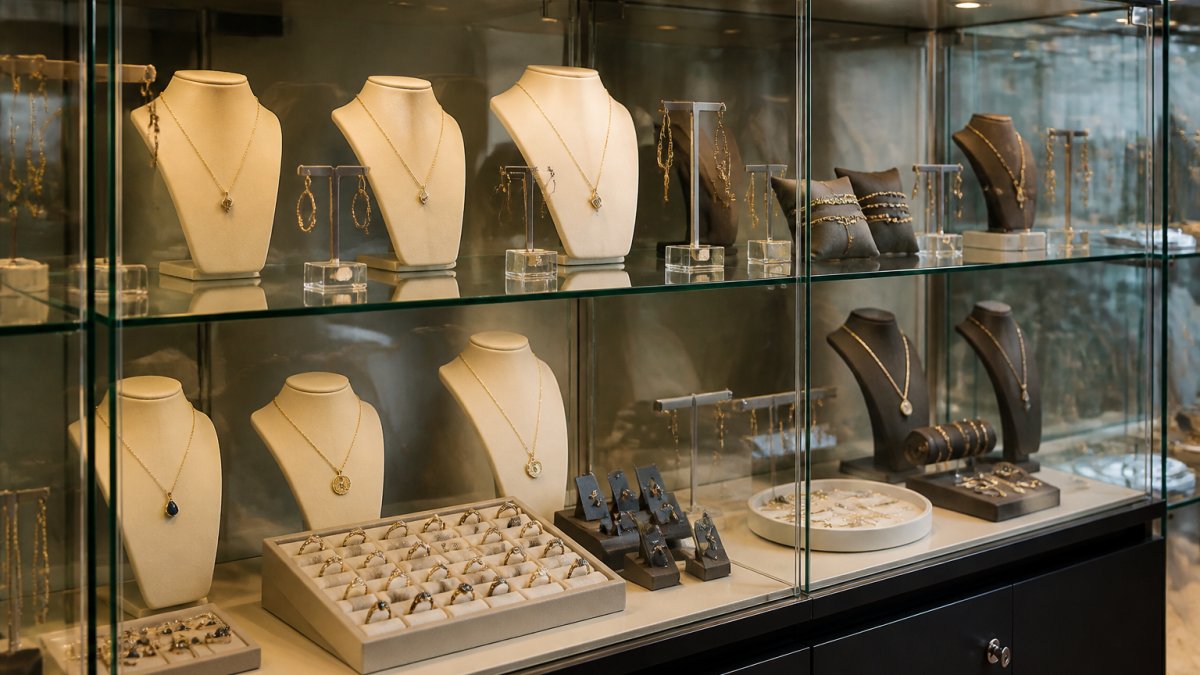
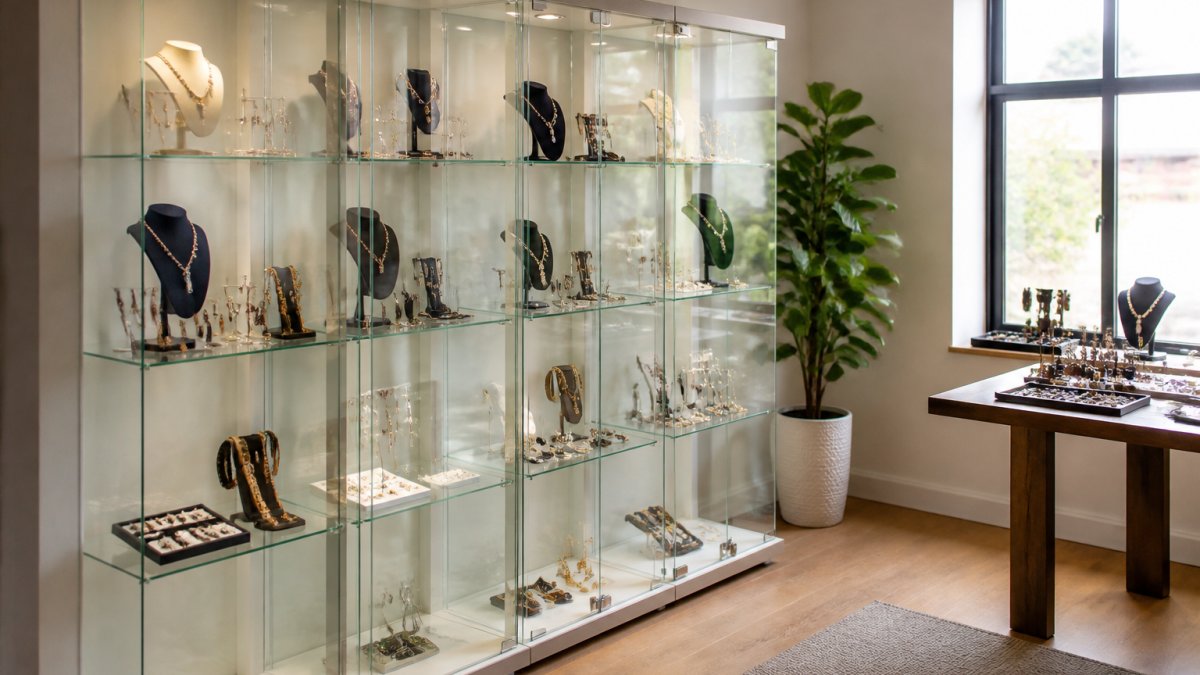
The interior does more work than the cabinet. A plain glass shelf with loose pieces looks like storage; the same shelf with trays, busts and risers looks like a display.
Start with height bands: necklaces on busts at the back, rings and earrings at the front where customers lean in. Velvet or suede trays stop pieces sliding and protect against scratches. Acrylic risers create a second tier without blocking the shelf above.
Keep one shelf for a single hero piece rather than filling every surface. Space signals value, and a crowded cabinet makes even good stock look like remaindered goods.
What Security Beyond a Basic Lock Looks Like
A lock stops the opportunist, not the determined thief.
Lock quality. Most retail showcases use a cam or lever lock operated by a small key.
Glass strength. Standard annealed glass breaks into large shards. Tempered glass is stronger and breaks into small cubes. Laminated glass holds together when broken because of the plastic interlayer.
Anchoring. Anchor units to the wall or floor using the manufacturer's fixing points, or a strap-and-bracket kit where none are supplied.
Visibility versus concealment. Glass on all sides maximises display but lets a thief see exactly what is inside and where the lock is. Half-vision units with solid backs and bases hide stock and fittings.
Key and access discipline. For shops, keep one named keyholder per shift, a written key log, and no spare key in a drawer or on a hook.
Alarms and detection. A standalone cabinet lock is deterrence, not detection. Where the collection justifies it, a door-contact alarm or vibration sensor adds a layer a lock cannot.
Care, Cleaning and Long-Term Maintenance
Clean glass with a non-ammonia cleaner and a microfibre cloth, working vertically rather than in circles to avoid streaks.
Dust the interior monthly and check shelf supports and door hinges every few months. A loose hinge is the usual cause of a door that no longer sits flush.
LED strips have a long life but the driver and connections are the parts that fail. If a section of lighting dims, check the connector before replacing the strip.
Choosing a jewellery cabinet comes down to matching the format to the job: flatpack or built for a home collection. Get the size and interior layout right and the cabinet earns its place for years.
At Display Cabinets UK, we supply lockable glass display cabinets with LED lighting, flatpack or with a build service, and free nationwide delivery. Tell us the room, the collection and the deadline, and we will help you specify the right unit. Check out our range to see the formats side by side.
Frequently Asked Questions
What are the best glass display cabinets for jewellery?
The best cabinet depends on your collection and setting. For home use, a lockable floor cabinet with adjustable glass shelves and LED lighting offers flexibility. Always check dimensions, shelf adjustability and whether the lock meets your security needs before buying.
Are lockable glass display cabinets suitable for valuable jewellery?
Yes, but the lock is only one part of security. Look for tempered glass, a sturdy metal frame and a lock that is integrated into the door rather than a simple catch. For high-value items, consider cabinets with internal anchoring points or choose a model that can be bolted to the wall or floor. Display Cabinets UK offers lockable cabinets with a build service. Always check the lock specification and ask about the glass thickness.
Is LED lighting useful in a jewellery display cabinet?
LED lighting is useful in a jewellery display cabinet. Display Cabinets UK supplies LED glass display cabinets. Avoid halogen bulbs, which emit heat and can damage delicate pieces over time.
What is the difference between a countertop and a full-height display cabinet?
A countertop showcase sits on an existing counter or table and is ideal for small items like rings and earrings, keeping them within easy reach. A full-height cabinet stands on the floor and offers more storage, often with multiple adjustable shelves and a lockable door. Full-height units suit larger collections or retail environments where customers browse standing up. Your choice depends on space, the size of your collection and whether you want to create a focal point or simply add display space.
How can I arrange jewellery attractively in a glass display cabinet?
Start by grouping items by type or colour, and use risers or stands to create height variation. Leave space between pieces so each one stands out. Use velvet or suede inserts to prevent scratching and add a luxurious feel. For necklaces, busts or T-bar stands work well; rings look best in compartment trays. Rotate your display regularly to keep it fresh.