 listicle
Best Glass Cabinets for Small Jewellery: 2026 Guide
Table of Contents
- Quick Comparison: Best Glass Cabinets for Small Jewellery
- Display Cabinets UK: Flatpack or Built, Locked and Lit
- BROTTAR Display Cabinet: Four Tiers for Tight Corners
- Nicetree 360° Swivel Jewelry Cabinet: Rotating Storage With Lights
- SONGMICS Wall-Mounted Cabinet: A Lockable Glass Display Cabinet for Tiny Rooms
- Displays2go Glass Showcase: Tempered Glass and Adjustable Shelves
- Coaster Curio Cabinet and Georgian Mahogany: Style-Led Picks
- How to Style a Glass Display Cabinet for Small Jewellery
- Frequently Asked Questions
Last Updated: September 16, 2026
Quick Comparison: Best Glass Cabinets for Small Jewellery
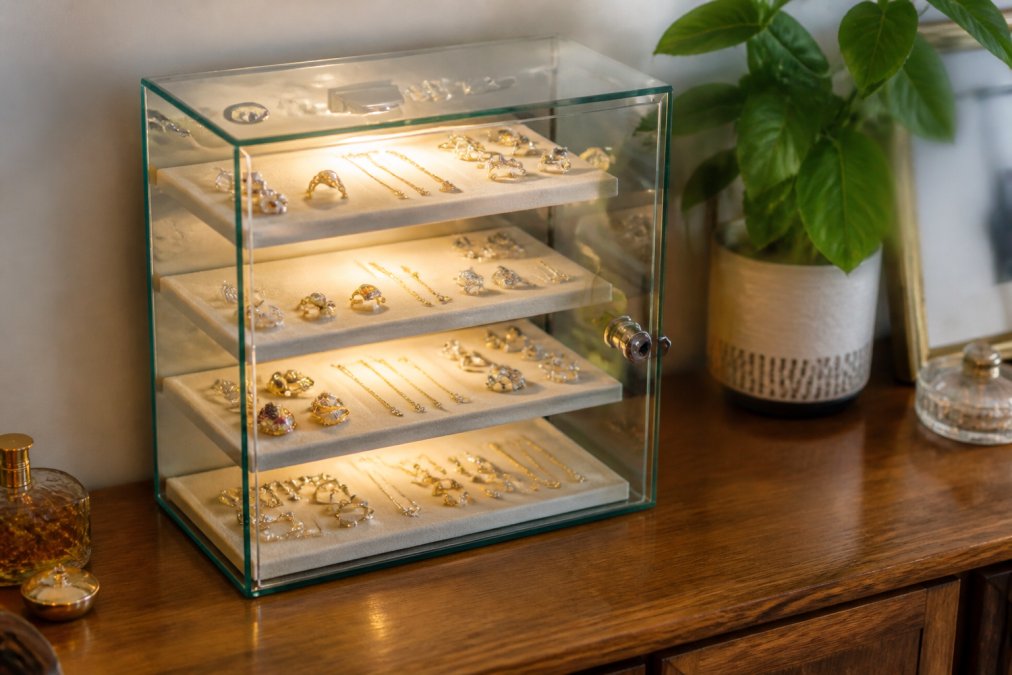
The best glass cabinets for small jewellery balance a compact footprint against security, visibility and lighting. This guide from Display Cabinets UK compares seven real options, from wall-mounted lockable units to bespoke retail showcases, so you can match a cabinet to your space and your collection.
Here is the short version before the detail:
| Cabinet | Best For | Lockable | Lighting | Approx. Price |
|---|---|---|---|---|
| Display Cabinets UK | Flatpack or built, locks and lights | Yes | Yes | Quote on request |
| BROTTAR Display Cabinet | Tight corners, four tiers | No | No | £120 |
| Nicetree 360° Swivel | Dressing rooms, rotating access | No | Yes | £185 |
| SONGMICS Wall-Mounted | Tiny rooms, wall fixing | Yes | No | £75 |
| Displays2go Glass Showcase | Retail-grade tempered glass | Yes | No | £250 |
| Coaster Curio Cabinet | Living room styling | No | No | £320 |
| Georgian Mahogany | Antique and vintage interiors | No | No | £150 |
Display Cabinets UK: Flatpack or Built, Locked and Lit
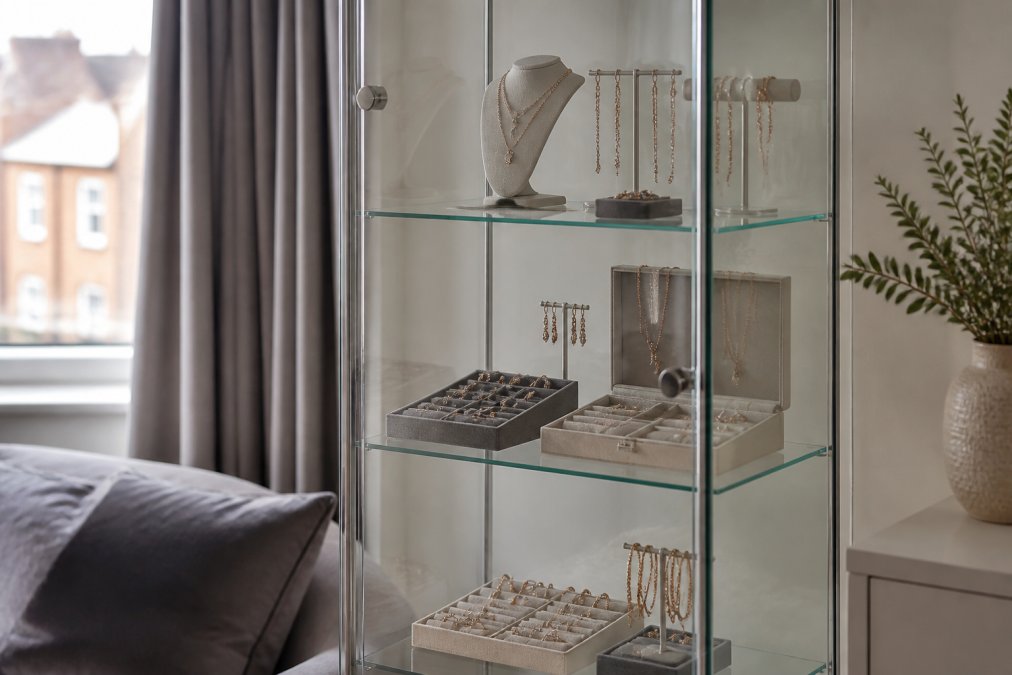
Our top pick is Display Cabinets UK, because it ships as a flatpack or arrives fully built, with locks and lights. Free nationwide delivery applies either way.
BROTTAR Display Cabinet: Four Tiers for Tight Corners
BROTTAR's four-tier unit answers a specific problem: you have a narrow gap beside a chimney breast or between a wardrobe and a wall, and you want vertical storage rather than a wide footprint. At around £120, it is the cheapest full cabinet on this list.
Nicetree 360° Swivel Jewelry Cabinet: Rotating Storage With Lights
Nicetree's rotating cabinet solves the access problem that plagues deep shelving: instead of reaching behind front-row items, the whole unit turns. Integrated LED lighting and dedicated hooks and slots keep necklaces untangled, and a full-length mirror on the exterior means it earns its floor space twice over.
SONGMICS Wall-Mounted Cabinet: A Lockable Glass Display Cabinet for Tiny Rooms
The SONGMICS UJJC51WT takes floor space out of the equation entirely. It fixes to the wall, opens on a hinged door, and lines the interior with velvet to protect delicate finishes. Multiple earring and necklace hooks handle small pieces well.
Displays2go Glass Showcase: Tempered Glass and Adjustable Shelves
Displays2go builds for retail, and it shows. Tempered glass construction, lockable doors and adjustable shelving heights make this the most adaptable cabinet on the list for a serious collection or a small shop counter.
Coaster Curio Cabinet and Georgian Mahogany: Style-Led Picks
Two options here are bought for how they look rather than how they lock. That is a legitimate reason to buy, but it comes with trade-offs worth understanding before you commit.
Coaster Modern Contemporary Curio Cabinet
Around £320, this uses glass side panels and shelves within a minimalist frame. It is the pick for a living room where the cabinet is part of the scheme rather than a storage solution.
- Construction. Tempered glass panels in a metal or wood-effect frame. Tempered glass is roughly four to five times stronger than annealed glass of the same thickness and, importantly, breaks into small blunt fragments rather than long shards, a meaningful safety point in a room with children or pets.
- Weight and moving. Once assembled it is heavy and awkward. Treat it as a two-person job and empty it completely before moving, even a short distance.
- Security. No lock. If you want to secure it, a small cabinet-mounted cam lock can be retrofitted by a locksmith, but it will not match the security of a purpose-built lockable display cabinet.
- Lighting. No integrated lighting, so budget for an LED strip or a small display spotlight.
Georgian Mahogany Small Cabinet
Roughly £150, this offers traditional wood craftsmanship with glass door and side panels in a compact size for a tabletop or corner.
- Construction. Solid wood frame with glass panels. The wood frame is more forgiving of minor knocks than an all-glass unit, and it hides dust ingress better at the joints.
- Size. Suited to a tabletop or corner. Check the depth before buying, mahogany pieces are often deeper than modern flatpacks, which matters in a narrow room.
- Security. No lock. The glass door is typically held by a small catch, which is fine for display but not for anything valuable.
- Lighting. No modern lighting. A warm-white LED puck light or a small strip is the usual addition, and it suits the traditional look better than cool white.
The security trade-off, honestly stated
Neither has a lock. Buy either for aesthetics and accept the security trade-off. If your collection includes anything you would not want to lose, the practical options are:
- Add a cam lock (a small cylinder lock fitted through the door or frame), cheap, effective against casual access, but not high-security.
- Add a glass-door cabinet lock with a keyed cylinder, a step up, and often retrofittable.
- Move high-value pieces into a lockable cabinet and keep the style-led unit for display of lower-value items.
How to Style a Glass Display Cabinet for Small Jewellery
Styling a small cabinet is about restraint and light, not filling every shelf. Group pieces by colour or metal, leave gaps, and let the lighting do the work. But the two things most guides skip are the ones that actually change how a collection looks: the colour temperature of the light, and how the cabinet sits in a genuinely small room.
Lighting colour temperature: the single biggest styling decision
Not all white light is the same. Colour temperature is measured in kelvin (K), and the difference between a 3000K and a 6000K LED is the difference between jewellery that glows and jewellery that looks flat and cold.
- 2700K-3000K (warm white). Flatters gold, rose gold, pearls, amber and coloured gemstones. This is the range most home collectors should default to. It reads as domestic rather than retail.
- 3500K-4000K (neutral). The safest all-rounder if your collection mixes warm and cool metals. Diamonds and platinum still look bright without the blue cast of cooler options.
- 5000K-6000K (cool white / daylight). Makes diamonds and white metals sparkle hardest, which is why retail counters use it. In a small domestic room it can look clinical and will make gold appear dull and yellow-grey by comparison.
Small-space ergonomics for home collectors
Most styling advice is written for retail, where the cabinet is the destination. At home, the cabinet has to live alongside a bed, a wardrobe or a dressing table. A few rules that make the difference:
- Respect the swing. A hinged glass door needs roughly its own width plus a hand's clearance to open comfortably. In a tight corner, a sliding or lift-off door beats a hinged one.
- Keep the top third for the pieces you wear most. Eye-level shelves get opened daily; the bottom shelf is where heirlooms and seasonal pieces belong.
- Leave the base plinth clear. A raised base lifts the cabinet visually and stops it looking bottom-heavy in a small room.
- Anchor it if it is tall. A floor-standing cabinet over about 1.2m should be fixed to the wall, both for safety and to stop it shifting when the door swings.
- Rotate seasonally. Swap pieces every few months so the display stays interesting without adding clutter.
Grouping and negative space
Group by metal first, then by colour. Three to five pieces per shelf is usually the ceiling before a small cabinet starts to look crowded. Vary shelf heights using adjustable positions so a tall pendant does not crowd a row of rings, and keep one shelf deliberately sparse as a visual breather.
Frequently Asked Questions
What is a good display cabinet for small collectables?
A good display cabinet for small collectables combines a compact footprint with adjustable shelves, so you can change shelf spacing as your collection grows. Look for tempered glass, a lockable door and dust-proof construction to protect items from knocks and dirt. Wall-mounted and countertop designs suit smaller rooms, while floor-standing cabinets with a 360-degree view work well in living areas or retail spaces. Check the weight capacity per shelf before buying, and confirm whether the cabinet arrives flatpack or pre-assembled.
What are the benefits of lockable glass cabinets for jewellery?
A lockable glass display cabinet keeps high-value pieces secure while still showing them off. The lock deters casual theft in a home or busy retail environment, and a hinged or sliding door with a proper latch also keeps dust off delicate items. Combined with tempered glass and a sturdy frame, a lockable cabinet protects against knocks as well as break-ins. If you display valuable jewellery regularly, check the lock type and how the door closes before you buy.
How do I choose the right size glass cabinet for my jewellery?
Measure the space you have first, including height clearance if you plan to place the cabinet under a shelf or window. For small jewellery, a countertop or wall-mounted cabinet often works better than a full-height unit. Check interior dimensions rather than just exterior ones, since shelf spacing and depth determine what actually fits. If you have necklaces, allow extra height; for rings and earrings, shallow drawers or trays inside the cabinet keep items organised without wasting space.
Are glass display cabinets with integrated lighting better for jewellery?
Integrated lighting makes a real difference for jewellery because it catches facets and metal finishes that overhead room lighting misses. A small glass display case with lights, ideally LED, highlights individual pieces and makes a collection look considered rather than cluttered. LED runs cool, so it will not heat delicate items or fade materials over time. Look for lighting you can adjust or switch off, and check the colour temperature suits the metals and stones you display.
Do glass display cabinets come pre-assembled or flatpack?
It varies. Some cabinets arrive fully assembled, some are flatpack for self-assembly, and some suppliers offer a build service on top of a flatpack option. Flatpack is usually cheaper and easier to transport through tight doorways, but assembly quality affects how solid the finished cabinet feels. If you want a cabinet ready for an event or renovation deadline, ask about build service lead times before ordering. Free delivery and a build option can offset the assembly hassle.