 listicle
Secure Display Cabinets for Retail: 2026 Buyer's Guide
Table of Contents
- Why Secure Display Cabinets Matter on the Retail Floor
- Quick Comparison: Types of Secure Display Cabinets
- 1. Freestanding Display Showcases: Full-Vision and Half-Vision
- 2. Countertop Security Cabinets and Retail Shop Counters
- 3. Lockable Glass Display Cabinets and Wall-Mounted Units
- 4. Bespoke and Custom Display Solutions for Your Retail Environment
- Retail Loss Prevention Strategies That Work With Your Cabinets
- Tempered Glass Display Cases: Material Specifications and Durability
- Frequently Asked Questions
Last Updated: September 14, 2026
Why Secure Display Cabinets Matter on the Retail Floor
Shrinkage drains retail margins, and the most exposed categories sell small, high-value items: jewellery, watches, electronics accessories, collectibles. Many independent retailers move stock behind the till or into a back room, which protects the product but kills the sale. Customers do not ask for what they cannot see.
This guide from Display Cabinets UK is built for the opposite strategy: keep high-value merchandise visible, touchable at eye level, and locked. We supply premium glass display cabinets with locks and lights, flatpack or built for you, with free nationwide delivery. Below, we break down the main types of secure display cabinets for retail.
The single most important decision you will make is not the cabinet style. It is the locking mechanism and the glass specification.
Quick Comparison: Types of Secure Display Cabinets
Different cabinets solve different problems. A countertop unit at the till point is not interchangeable with a freestanding showcase, and neither replaces a wall-mounted unit in a narrow shop. Use the table below to shortlist by use case.
| Cabinet Type | Best For | Security Level | Floor Space Needed |
|---|---|---|---|
| Freestanding showcase | High-visibility product displays | High with locking doors | Large |
| Countertop security cabinet | Impulse buys at the till point | Medium to high | None |
| Lockable glass wall unit | Small retail spaces | Medium to high | None |
| Bespoke build | Awkward layouts, premium brands | Specified to requirement | Varies |
How We Evaluated These Cabinets
Four criteria decide whether a cabinet earns its place: how well it protects stock, how much product it lets the customer see, how durable the frame and glass are under daily use, and how easily it fits your space. A cheap cabinet that rattles, fogs, or fails at the lock is the most expensive purchase in the shop.
1. Freestanding Display Showcases: Full-Vision and Half-Vision
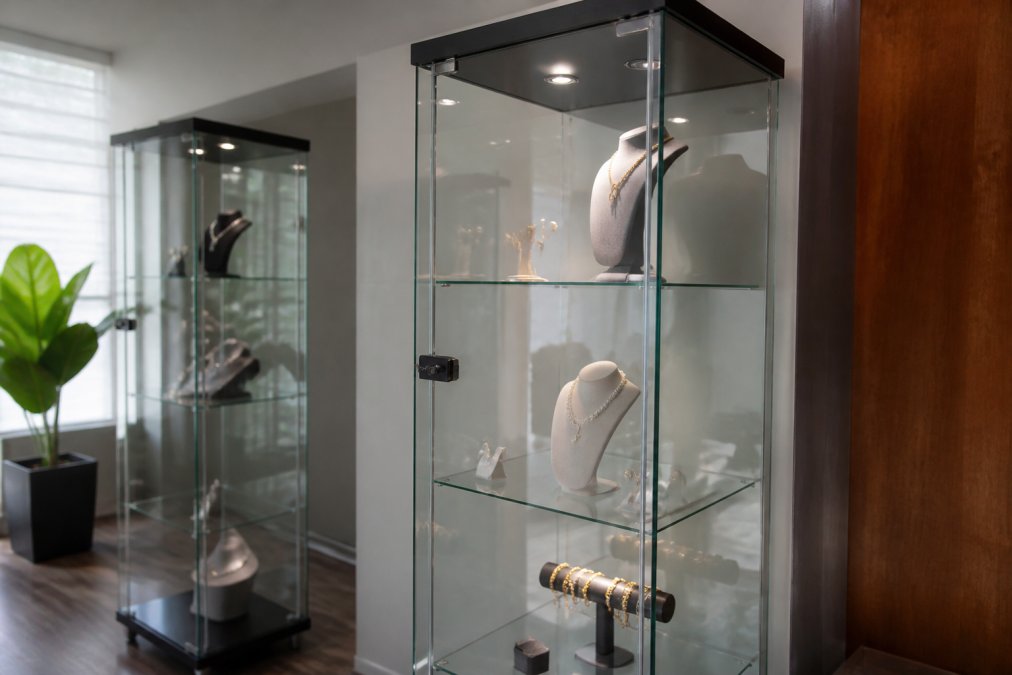
Freestanding display showcases are the workhorse of the retail floor: a full display volume with lockable access, and the default choice for jewellery, watches, and premium accessories.
Two configurations dominate. Full-vision cases use glass on all sides, so customers see the merchandise from any angle. Half-vision cases pair a glass upper section with a solid lower section, giving locked storage beneath the display for replenishment without a trip to the back room.
Health and Safety Executive guidance on safe retail premises is worth reading before you finalise floor layout, particularly on stability and access routes in customer-facing areas.
2. Countertop Security Cabinets and Retail Shop Counters
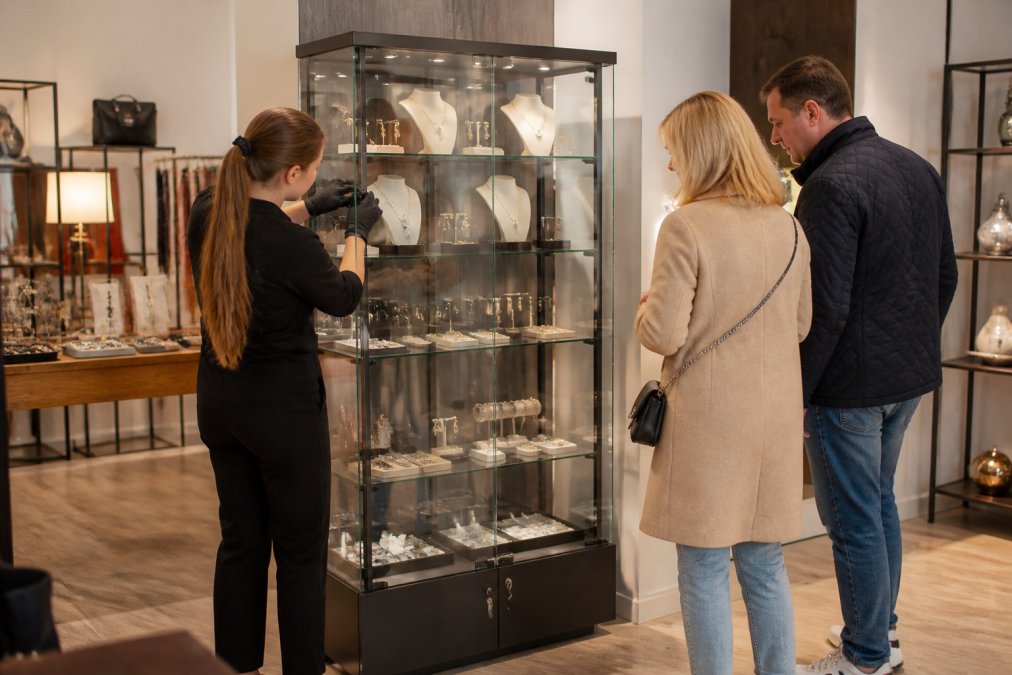
Countertop security cabinets sit on retail shop counters and put small, high-value stock in front of the customer at the moment of decision. This is where impulse purchases happen, and where theft is easiest, because staff attention is divided at the till point.
A lockable countertop unit solves both problems: staff control access, the glass keeps product visible, and the small footprint fits almost any counter without a refit. The limitation is capacity, these units hold a curated selection, not a full inventory.
Pair them with a properly specified till point and you have a merchandising position that earns its space. The British Retail Consortium's retail crime and loss guidance is a useful reference on how loss concentrates around till areas.
3. Lockable Glass Display Cabinets and Wall-Mounted Units
Lockable glass display cabinets mounted to the wall are the answer when floor space is the constraint. They keep high-value items at eye level, out of reach, and visible from across the shop, freeing floor space for customer movement.
The trade-off is installation. A wall-mounted unit is only as secure as the wall it is fixed to, so mounting hardware and wall construction matter more here than with any freestanding option. On older or hollow walls, a freestanding unit is often the more honest choice.
4. Bespoke and Custom Display Solutions for Your Retail Environment
Bespoke and custom display solutions exist for layouts standard sizes refuse to fit: corner returns, alcoves, angled walls, counters with an awkward run. A custom-built unit uses the space you have rather than forcing you to rearrange the shop around a stock size.
Material and finish choices matter most here, because a bespoke cabinet is a permanent fixture. Aluminium frame profiles, glass thickness, shelf adjustability, internal LED lighting, and lock type are all specified at the point of order.
Display Cabinets UK supplies both flatpack and built options with free nationwide delivery.
Retail Loss Prevention Strategies That Work With Your Cabinets
Retail loss prevention strategies only work when the physical setup supports them. A lock is one layer in a system that includes how stock is counted, how keys are controlled, and how the floor is watched. What most buying guides skip is choosing a cabinet whose locking and positioning actually support the strategy you intend to run.
Start with the lock, not the cabinet
Locks on retail display cabinets fall into a few broad families:
- Cam locks, the small cylindrical lock found on most countertop and wall units. Cheap, simple, and adequate for deterring opportunistic theft, but not designed to resist a determined attack; a cam lock on a thin panel can often be defeated by forcing the door.
- Ratchet or push locks, common on sliding-door showcases. They hold the door in position but offer limited resistance if the glass is flexed.
- Multi-point locking, found on better freestanding showcases, where the door engages the frame at two or more points. This is the single biggest upgrade in real-world security, because it stops the door being prised at the corner opposite the lock.
- Central locking systems, one key operates multiple cabinets. Useful for a shop with several cases, but a single lost key compromises every unit. Keep a signed key register and a spare set held off-site.
When a supplier describes a cabinet as "secure", ask which of these it uses.
Key control is where most shrinkage actually happens
A common pattern in small retail: the cabinet lock is fine, but the key lives in the till drawer, on a hook behind the counter, or is held by three staff with no record. Then the lock is decorative. Practical key control means:
- One named key holder per shift, recorded in a simple log
- A spare set held securely off the shop floor
- Keys returned and signed back in at close, not taken home
- Locks re-keyed or replaced when a key holder leaves
This costs nothing and closes the most common gap.
Position the cabinet where the lock can do its job
A lock buys you time; positioning decides whether that time is useful. A cabinet in a blind corner, behind a pillar, or facing away from the till gives a thief privacy to work on the lock. The practical rule: any locked case should be visible from at least one staffed position at all times during trading hours.
For countertop cabinets this is straightforward, they sit at the till. For freestanding showcases, think about the walking route staff take through the shop, not just the customer's route.
Layer the physical setup
- Lock every case at close, and log who holds each key
- Keep high-value stock in the locked lower section of half-vision units, not on open shelves
- Position countertop cabinets within direct staff sightlines from the till point
- Count high-value lines daily rather than weekly, so a loss shows up fast
- Keep internal LED lighting on during trading hours, because dark corners hide both stock and theft
- Fix wall-mounted units into solid structure, not plasterboard, so the cabinet cannot simply be pulled off the wall
Tamper-resistant locking and toughened glass raise the effort required to steal. Most opportunistic theft is deterred by effort, not by alarms.
Where to get sector-specific guidance
The British Retail Consortium's retail crime and loss guidance is a useful reference on how loss concentrates around till areas and how different retail sectors experience shrinkage. For the physical security side, the Secured by Design guidance on commercial premises sets out the police-preferred approach to locks, glazing and fixings on commercial property, and is worth reading before you specify a bespoke unit.
Assembly, delivery and installation
How the cabinet arrives affects both security and timeline. Flatpack cabinets are cheaper to ship and easier to get through a narrow shopfront, but they depend on the assembler getting the frame square and fixings tight, a badly assembled cabinet will not lock cleanly. Pre-assembled units remove that risk but need door access and a delivery slot that fits your trading hours. For a bespoke unit, confirm whether it arrives built or in sections, and who fixes it.
Tempered Glass Display Cases: Material Specifications and Durability
Tempered glass display cases use heat-treated glass that is significantly stronger than standard annealed glass and breaks into small, blunt fragments rather than long shards. That combination of strength and safe break behaviour makes tempered glass the default for retail display. But "tempered" alone tells you little, two cabinets both described as tempered can differ enormously under real impact.
What to actually look for in the glass specification
In the UK, the benchmark for safety glass in retail is BS EN 12150 (thermally toughened soda lime silicate safety glass).
Thickness is the other variable that matters. Common specifications on retail display cabinets are:
- 4 mm, light-duty, suitable for countertop units holding small items where impact risk is low
- 5-6 mm, the practical default for freestanding showcases and wall units in most shops
- 8 mm and above, specified for large spans, tall units, or where the cabinet is in a high-traffic position
A thicker pane is not automatically more secure. A 6 mm toughened pane correctly fitted into a rigid frame will outperform a poorly seated 8 mm pane every time, because the failure point is usually the frame or the fixing, not the glass itself.
Laminated glass: the option most buyers overlook
Where merchandise value justifies it, laminated glass is worth considering. It bonds two panes around a plastic interlayer, so even when the glass breaks the fragments stay in place and the panel stays in the frame, delaying entry in a way toughened glass alone does not. It is heavier and more expensive, and over-specified for most independent retailers, but for a jeweller or watch retailer with a single high-value case it is a legitimate upgrade.
Acrylic: where it still makes sense
Acrylic is lighter, cheaper to replace, and resists impact without shattering, but it scratches easily and clouds under regular cleaning, which matters when the point of the cabinet is premium presentation. It suits temporary displays, pop-up shops, market stalls, or low-value stock moved frequently, but is a poor choice for a permanent fixture.
| Specification | Toughened Glass (BS EN 12150) | Laminated Glass | Acrylic |
|---|---|---|---|
| Impact resistance | High | High, and holds together after break | High |
| Scratch resistance | High | High | Low |
| Clarity over time | Stays clear | Stays clear | Clouds with cleaning |
| Weight | Heavy | Heaviest | Light |
| Break behaviour | Blunt fragments | Held in frame | Cracks or crazes |
| Best for | Most permanent retail fixtures | High-value single-item cases | Temporary or low-cost displays |
The frame is half the specification
Durability also depends on the frame. An aluminium frame holds alignment far better than thin metal or plastic, preventing the rattling and dust ingress cheaper flatpacks are known for. Look for welded or mechanically locked corners rather than a single screw per joint, corner joints fail first, and once a frame racks out of square the doors stop meeting the lock properly.
Cleaning and maintenance
Glass clarity is a maintenance issue, not just a purchase decision. Use a non-ammonia glass cleaner and a microfibre cloth; ammonia and abrasive pads haze toughened glass over time and destroy acrylic within months. Wipe lock cylinders and hinges with a dry cloth only, solvent-based cleaners strip the internal lubricant and cause stiff or seized locks. Check door alignment every few months; a door that has dropped slightly will not engage the lock fully even when it appears shut.
Frequently Asked Questions
What are the best materials for secure retail display cabinets?
Toughened (tempered) glass is the standard for secure display cabinets because it resists impact and breaks into small blunt pieces rather than sharp shards. For higher security, laminated glass holds together when struck, delaying forced entry. Aluminium frames offer a good strength-to-weight ratio and resist warping. Acrylic is lighter and cheaper but scratches easily and offers less resistance to determined break-ins. For high-value items, specify toughened glass with a reinforced aluminium frame and a multi-point locking mechanism.
How do lockable display cabinets help reduce retail theft?
Lockable cabinets remove the opportunity for quick grab-and-run theft by keeping high-value items behind glass with a keyed or coded lock. Combined with staff training and strategic placement near the till point, lockable units reduce shrinkage significantly. They also allow you to display premium goods without keeping them in a back room, so you maintain visual merchandising impact while protecting stock. Choose tamper-proof locking mechanisms and avoid leaving keys in accessible locations.
Are glass display cabinets with lights better for product perception?
Yes. LED lighting integrated into glass display cabinets improves product visibility and makes merchandise appear more premium. Warm white LEDs (around 3000K) suit jewellery and collectibles, while cool white (4000K-5000K) works well for electronics and fashion. LED strips also produce minimal heat, so they will not damage sensitive items. The lighting draws the eye to the display, increasing the chance of a sale without needing staff to point items out.
What is the difference between tempered and laminated glass for retail security?
Tempered glass is heat-treated for strength and breaks into small granular pieces when it fails, reducing injury risk. Laminated glass consists of two glass layers bonded to a plastic interlayer; when struck, it cracks but stays in place, providing a physical barrier that slows intruders. For most retail displays, tempered glass offers a good balance of safety and cost. For high-risk items or overnight security, laminated glass is the stronger choice because it resists penetration even after breaking.
Do I need a professional build service for retail display cabinets?
A build service is worth considering if you need the cabinet assembled on site, have multiple units, or want to avoid the time and risk of flatpack assembly. If you order flatpack, check that the supplier offers support and clear instructions. For urgent deadlines, ask about lead times before ordering.
The real challenge with secure display cabinets for retail is not choosing a style. It is finding a unit that locks properly, stays rigid after years of daily use, and still looks good enough to sell the product inside it. Display Cabinets UK supplies premium glass display cabinets with locks and lights, available flatpack or with a build service, plus free nationwide delivery. Check out the range and get your display secured before your next deadline.