 how-to
How to Assemble Glass Display Cabinets: 2026 Guide
Table of Contents
- Before You Start: What You'll Need for Assembly
- Step-by-Step: How to Assemble Glass Display Cabinets
- How to Level a Display Cabinet on Any Floor
- Glass Handling and Safety During Assembly
- Wall Anchoring and Tip-Over Prevention
- When to Use a Glass Display Cabinet Assembly Service
- Troubleshooting Common Assembly Problems
- Frequently Asked Questions
Last Updated: September 26, 2026
Before You Start: What You'll Need for Assembly
Most flat-pack display cabinets end up wobbly or dusty because of one thing: rushed assembly. Getting the prep right takes 15 minutes and saves hours of frustration.
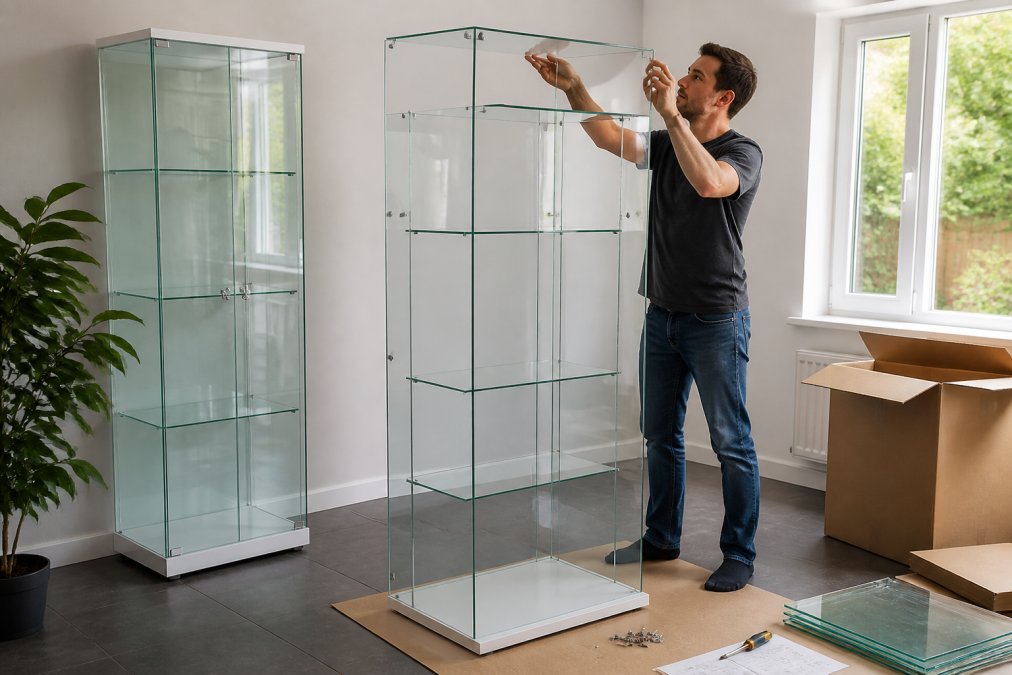
We supply premium glass display cabinets as flat-pack units, complete with locks and lights, plus a build service if you'd rather skip the tools entirely. This guide walks you through how to assemble glass display cabinets properly, whether you're setting up a home display or a retail showcase.
Before you touch a single panel, gather these essentials:
- Allen key (usually included in the hardware pack)
- Screwdriver (Phillips and flathead)
- Spirit level (critical for cabinet alignment)
- Tape measure
- Protective mat or blanket (for glass handling)
- Suction cups (for manoeuvring large glass panels)
- A second person (non-negotiable for safety)
The Royal Society for the Prevention of Accidents guidance on home safety highlights that handling glass and heavy furniture is a common cause of household injuries. Don't skip the safety basics.
Essential tools and hardware
Check your hardware pack against the instruction manual before starting. Missing a cam lock or shelf clip halfway through assembly means a frustrating delay.
Key components to identify:
- Cam locks and dowels
- Pre-drilled holes on side panels
- Shelf clips
- Hinge adjustment screws
- Base plate and top canopy
- Magnetic catch
- Leveling feet
- Anchoring kit
Unpacking and identifying components
Lay everything out on your protective mat. Group similar parts together.
Check each glass panel for damage before assembly. Once it's built, it's much harder to prove a fault was there from the start. The Glass and Glazing Federation's guidance on handling glass safely recommends inspecting edges and corners carefully, as these are the most vulnerable points.
Label panels with masking tape if the manual uses codes. It sounds fussy. It saves time.
Step-by-Step: How to Assemble Glass Display Cabinets
Here's the process, broken into four clear stages.
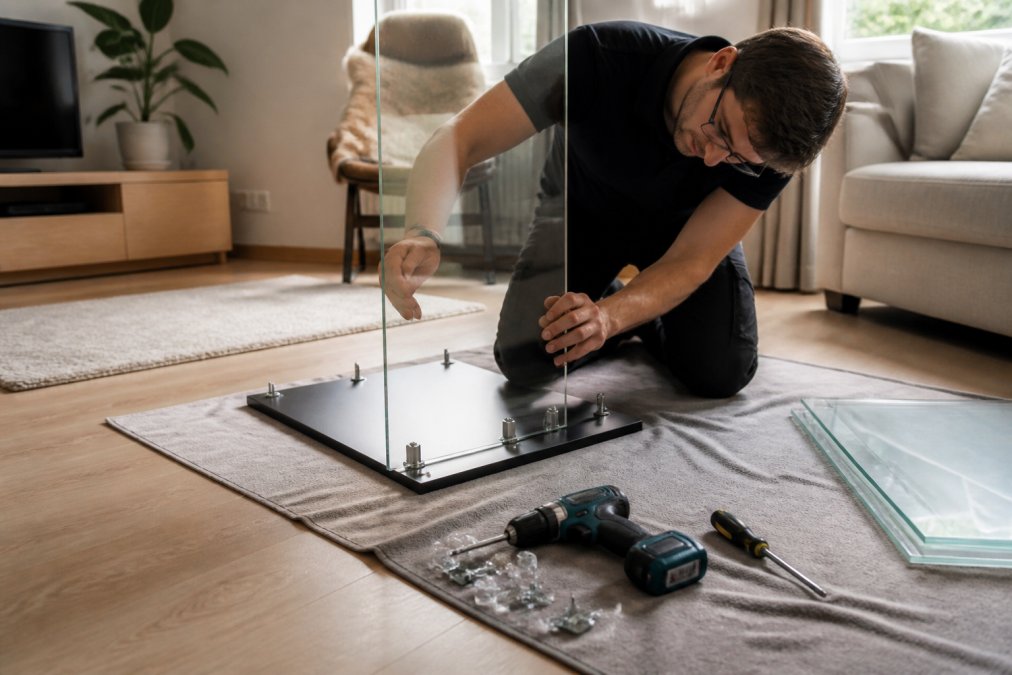
Step 1: Prepare the base and side panels
Attach the leveling feet to the base plate first. This makes levelling much easier later.
Stand the base on your mat. Insert cam locks and dowels into the pre-drilled holes on each side panel. Most flat-pack furniture uses a cam-and-dowel system: the dowel slots into the panel, and the cam lock tightens it from the inside.
Line up the side panels with the base. Insert the connecting bolts and turn the cam locks clockwise until they lock. Don't overtighten. You'll strip the fitting.
Glass-specific technique: When you offer a glass side panel up to the base, keep the panel vertical and lower it straight down rather than sliding it across the base. Sliding drags the tempered edge across the hardware and is a common cause of edge chips.
Step 2: Install the back panel and top canopy
Slide the back panel into the grooves on the side panels. This adds structural integrity to the whole frame.
Step 3: Fit the glass doors and hinges
This is where most people struggle. Glass door hinges need careful adjustment.
Step 4: Install shelves and lighting
Fit the shelf clips into the pre-drilled holes at your chosen heights. Slot the glass shelves in gently.
Cam-lock mechanics: why they fail and how to seat them
A cam lock is a cylindrical fitting that sits in a hole in one panel and rotates to grip a dowel inserted from the adjoining panel. It only tightens if the dowel is fully home and the cam arrow points toward the dowel hole before you turn it.
Common failure pattern:
- Cam turns freely but never tightens, the dowel isn't fully seated, or the cam is rotated 180 degrees out of alignment.
- Cam jams halfway, the panel isn't flush, so the dowel is entering at an angle.
- Cam strips, you've overtightened. Back it off a quarter-turn and reseat.
How to Level a Display Cabinet on Any Floor
A level cabinet is a stable cabinet. Uneven floors are the enemy of glass display units.
| Problem | Likely Cause | Fix |
|---|---|---|
| Door swings open | Cabinet not level | Adjust leveling feet |
| Door rubs frame | Hinge misaligned | Turn hinge adjustment screws |
| Cabinet rocks | Uneven floor | Use shims under feet |
| Shelves wobble | Shelf clips not seated | Push clips fully into holes |
Glass Handling and Safety During Assembly
Tempered glass is strong, but edges are vulnerable. One sharp knock on a corner can cause the whole panel to shatter. This is the section most assembly guides skip, and it's where most damage happens.
Tempered glass: what makes it different
Tempered glass is heat-treated so the outer surfaces are in compression and the core is in tension. That makes the face very strong, it resists impact far better than ordinary glass. But the edges are the weak point. A chip or nick on an edge concentrates stress and can trigger a full-panel shatter, sometimes minutes after the impact.
Practical consequences for assembly:
- Never rest a glass panel on its edge on a hard floor. Use a padded mat.
- Never drag a panel across a surface. Lift it.
- Never strike a panel to "seat" it. If it won't seat, the frame is out of square.
- Keep the panel flat or upright. Leaning a panel at an angle against a wall is the most common cause of a slide-and-fall.
Handling technique
Always wear gloves when handling glass panels. Use suction cups for anything larger than a small shelf. Never lift glass alone if it's more than you can comfortably manage.
Suction cup placement matters more than most people realise:
- For a door or side panel, place cups 100-150 mm in from each corner.
- For a shelf, one central cup is usually enough.
- Test the seal by lifting a few centimetres before committing to a full lift.
- Never use a cup on a chipped or scratched area, the seal won't hold.
Wall anchoring and tip-over prevention
Tall glass display cabinets can tip if someone leans on an open door or a child climbs them. An anchoring kit fixes this.
Wall fixings by wall type:
- Solid masonry: use a masonry plug and screw. Drill to the plug's stated diameter, not larger.
- Plasterboard with a stud behind: screw directly into the stud. Use a stud finder.
- Plasterboard without a stud: use a hollow-wall anchor rated for at least twice the cabinet's loaded weight.
- Dot-and-dab plasterboard: treat as hollow wall unless you can confirm a stud.
Wall Anchoring and Tip-Over Prevention
Tall glass display cabinets can tip if someone leans on an open door or a child climbs them. An anchoring kit fixes this.
When to Use a Glass Display Cabinet Assembly Service
Not everyone wants to build their own. If you're short on time, lack the tools, or the cabinet is particularly large, a professional assembly service makes sense.
Signs you should book a service:
- The cabinet is taller than 1.8 metres
- It has integrated lighting you're unsure about wiring
- You don't have a second person to help
- You need it done quickly and correctly first time
Troubleshooting Common Assembly Problems
Doors don't align properly. Check the cabinet is level first. If it is, adjust the hinge screws. Small quarter-turns make noticeable differences.
Frequently Asked Questions
Do I need two people to assemble a glass display cabinet?
Yes, for most glass display cabinets you need two people. Glass panels are heavy and awkward to handle alone, and a second person helps prevent drops or stress cracks. One person can hold the panel steady while the other secures screws or cam locks. If you are assembling a small unit with thin glass, one person may manage, but two is always safer.
What tools are required to build a flatpack glass cabinet?
You will typically need an Allen key (often supplied), a screwdriver, a rubber mallet, a spirit level, and a tape measure. A cordless drill with a low torque setting speeds up cam lock and dowel installation. Keep a soft cloth and suction cups on hand for lifting glass panels. Check the hardware pack and instruction manual first, as some cabinets include specialised fixings.
How do I ensure a glass display cabinet is stable?
Level the cabinet using adjustable feet on a solid floor, then anchor it to the wall with the supplied anchoring kit or a suitable wall fixing. Push the cabinet gently to check for movement. For taller units, wall anchoring is essential to prevent tip-over. Also ensure all cam locks, dowels, and shelf clips are fully tightened before loading glass shelves.
Are there professional assembly services for glass display cabinets?
Yes, a glass display cabinet assembly service is useful if you are short on time, lack tools, or want to avoid handling glass yourself. A professional service typically includes delivery, full assembly, levelling, and sometimes wall anchoring. Check lead times and whether the service covers your area before ordering.
Assembling a glass display cabinet isn't complicated, but it rewards patience. Rushed builds lead to wobbly frames, misaligned doors, and scratched glass.
Display Cabinets UK supplies premium glass display cabinets with locks and lights, delivered free nationwide. Choose flat-pack if you're confident with tools, or let our team handle the build for you. Every cabinet is designed for stability, security, and a professional finish. Check out our range and find the right display for your space.