 listicle
Custom Glass Display Cabinets 2026: Top Picks & Guide
Table of Contents
- Quick Comparison: Custom Glass Display Cabinets for 2026
- Display Cabinets UK: Bespoke Craftsmanship and Build Service
- IKEA PS 2026 Glass-Door Cabinet: Affordable Style
- Stoll Industries: Custom Metal and Glass Cabinets
- Displays2go: Professional-Grade Glass Display Cases
- Lockable Glass Cabinets with Lights: Security Meets Style
- White Display Cabinet: A Timeless Choice for Modern Interiors
- Glass Cabinet Installation Service: Flatpack vs Professional Build
- Frequently Asked Questions
Last Updated: September 22, 2026
Quick Comparison: Custom Glass Display Cabinets for 2026
Custom glass display cabinets are bespoke units built to exact dimensions, combining tempered safety glass with solid frames to protect and present valuable items. This guide compares leading display cabinet options, from budget flatpacks to high-end cabinetry.
Here's the shortlist:
| Cabinet | Best For | Key Feature | Pricing |
|---|---|---|---|
| Display Cabinets UK | Bespoke homes and retail | Lockable, lit, flatpack or built | Bespoke quote |
| IKEA PS 2026 | Affordable home style | Tempered glass doors | £249.99 |
| Stoll Industries | Architectural fit-outs | Fully custom metal frames | Bespoke quote |
| Displays2go | Retail environments | Lockable doors, lighting | Contact for pricing |
Display Cabinets UK: Bespoke Craftsmanship and Build Service
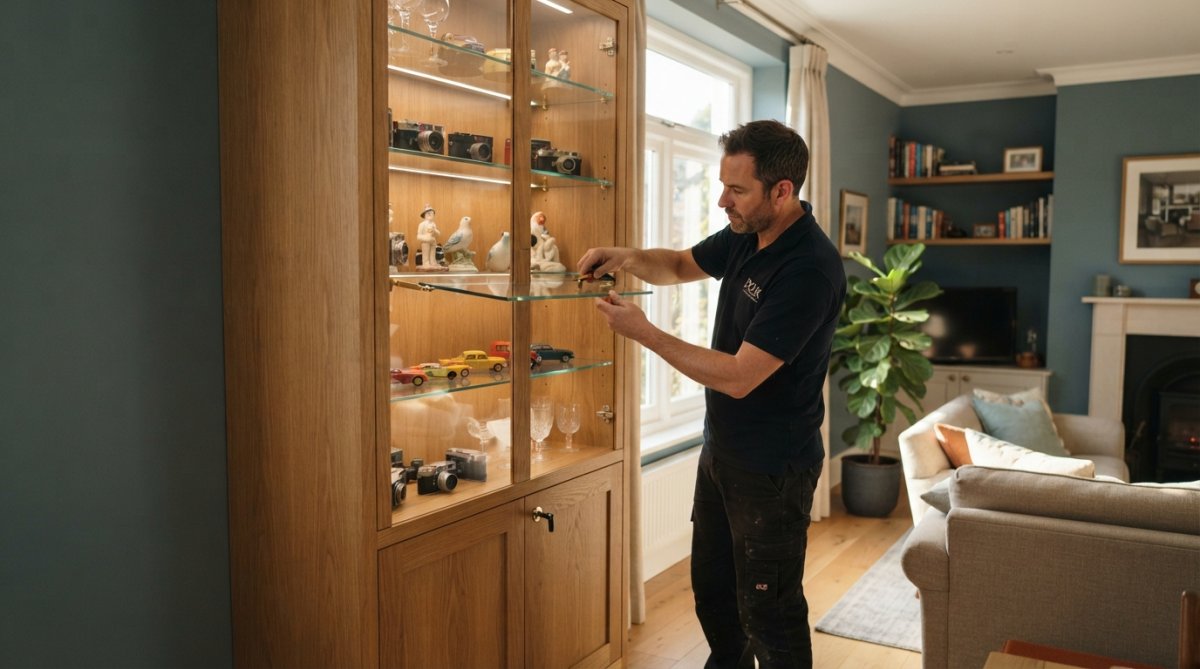
For small business owners, these units look professional enough for retail, not just home use.
IKEA PS 2026 Glass-Door Cabinet: Affordable Style
The IKEA PS 2026 is the budget-friendly choice for homeowners who want style without a bespoke price tag. At £249.99, it delivers tempered safety glass doors and adjustable shelving in a minimalist frame.
Stoll Industries: Custom Metal and Glass Cabinets
Stoll Industries builds high-end metal and glass cabinetry tailored to exact architectural requirements, for residential or commercial projects where the cabinet must fit a specific space precisely.
Displays2go: Professional-Grade Glass Display Cases
Displays2go offers a broad catalogue of professional-grade glass display cases for retail and home use. Lockable doors and integrated lighting come as standard on many models, with finishes including aluminium and wood veneer.
Lockable Glass Cabinets with Lights: Security Meets Style
Lockable glass cabinets with lights solve two problems at once: keeping valuable items secure and making them look worth displaying. But the difference between a cabinet that deters and one that merely looks the part comes down to specification.
Lock types and what they actually resist
Not all locks are equal, and the fitting method matters more than the brand:
- Cam locks are the most common on retail cabinets: cheap, simple, and adequate for keeping casual hands out, but one mounted into thin MDF or a hollow frame can be levered out in seconds. Look for a cam lock seated in a solid timber or metal block.
- Deadbolt and mortice locks are the step up for high-value displays. A mortice deadbolt set into the frame resists forced entry far better than a surface-mounted cam lock, because the bolt engages the frame itself rather than a screwed-on plate.
- Ratchet and cylinder locks are common on museum-grade and jeweller's cabinets. They allow keyed-alike sets so one key opens a whole run, which matters in retail where staff need quick access.
- Electronic and smart locks are the 2026 growth area. Keypad, fob, and app-controlled locks let you issue and revoke access without rekeying, and some log every opening, the biggest gap in most buying guides.
Glass specification: what the numbers mean
Security is not only about the lock. The glass is the largest opening in the cabinet, and its specification determines how long it resists a smash-and-grab.
- Toughened (tempered) safety glass is the baseline. Heat-treated to break into small blunt granules rather than long shards, it is the default for homes with children or pets, though it can shatter suddenly if the edge is damaged.
- Laminated glass holds together when broken because a plastic interlayer bonds the panes. It is slower to get through and better where contents are genuinely valuable.
- Laminated toughened glass combines both: the impact resistance of toughened glass with the hold-together behaviour of laminated. It is the specification most used in museum-grade and high-street jeweller displays.
Lighting: why LED is now the only sensible choice
Lighting should be LED: it runs cooler than halogen, uses a fraction of the power, and will not fade sensitive items such as textiles, watercolours, or autographed memorabilia. For 2026, the practical specification points are:
- Colour temperature: around 3000K for a warm, domestic feel; 4000K for retail where you want items to read as crisp and neutral.
- Colour rendering (CRI): look for CRI 90 or above. Below that, reds and skin tones in photographs and artwork look muddy.
- Dimmability and control: many modern LED strips are dimmable and can be run from a remote, wall switch, or app, where smart-home integration becomes relevant, covered below.
- Heat and wiring: LED strips generate little heat, so they can sit close to the glass without risk. Ask how the wiring is routed, because a visible cable down the outside undoes the whole effect.
Smart-home integration: the angle most guides miss
Most buying guides still treat display cabinets as passive furniture. In 2026 that is increasingly wrong. A high-end cabinet can be integrated into a smart home in three ways:
Check out →
- App-controlled or voice-controlled lighting. Smart LED drivers can link to a home hub so cabinet lights come on with a scene, schedule, or voice command, useful for retail window displays that must switch on at set times without staff.
- Smart locks with access logging. Electronic locks can tie into a broader access system, so a cabinet in a shared office or retail unit records who opened it and when. For a home collector the benefit is simpler: no lost keys and no locksmith bill.
- Environmental monitoring. Small sensors can track temperature and humidity inside the cabinet and alert you if conditions drift. This matters for anything sensitive to damp, from antique books to certain collectibles.
White Display Cabinet: A Timeless Choice for Modern Interiors
A white display cabinet is the safest bet for modern interiors because it disappears into the room and lets your items take centre stage. White frames work in living rooms, home offices, and retail spaces without clashing with decor. But the colour is only half the decision: the finish and material behind it determine how the cabinet ages and cleans.
Finish options and how they behave
"White" covers a wide range of surfaces, and they are not interchangeable:
- Sprayed or lacquered MDF gives the smoothest, most uniform finish and takes a colour match well. It is the usual choice for bespoke cabinetry because it can be built to any size and curved or angled where needed. The trade-off: chips on edges are hard to touch up invisibly.
- Powder-coated metal is the retail workhorse: hard-wearing, easy to wipe down, and more knock-resistant than a painted timber edge. It suits frameless and slim-frame designs.
- Melamine-faced board is the budget option: durable enough for a spare room or rental, but edges rely on matching tape and can lift over time in damp rooms.
- Solid timber with a white wash or paint is the premium route: warmer than MDF and can be sanded back and refinished, but heavier, more expensive, and painted timber can show grain through the finish.
The sustainability angle most guides ignore
Most competitors focus purely on aesthetics. In 2026, buyers increasingly ask what a cabinet is made of and where it ends up at end of life. The practical questions for any supplier are:
- Timber sourcing. Ask whether the timber or board comes from responsibly managed forests (What is FSC?). FSC and PEFC are the recognised certification marks to look for on the paperwork, not just the marketing copy.
- Board and adhesive emissions. Low-emission boards and low-formaldehyde adhesives are widely available and worth specifying for bedrooms, nurseries, and any enclosed space.
- Recycled content. Powder-coated steel frames and aluminium components often contain significant recycled content, and both are highly recyclable at end of life. A metal-framed cabinet is usually easier to recycle than a mixed-material one.
- Lighting efficiency. LED lighting is cooler and longer-lasting than halogen and draws a fraction of the power, which matters if the cabinet is lit for long periods in retail.
- Repairability. A cabinet with replaceable glass panels, adjustable shelves, and standard hinges lasts longer than one glued and sealed together. Longevity is the most effective sustainability measure of all.
Restyling and longevity
Display Cabinets UK builds white cabinets to exact dimensions with a choice of finishes.
Glass Cabinet Installation Service: Flatpack vs Professional Build
Here's how the two compare:
| Factor | Flatpack | Professional Build |
|---|---|---|
| Upfront cost | Lower | Higher |
| Time to ready | Hours to a weekend | Usually same day |
| Risk of damage | Higher during assembly | Minimal |
| Tools needed | Basic DIY kit | None |
| Best for | Confident DIYers | Busy buyers, retail deadlines |
Display Cabinets UK offers both options with free nationwide delivery, so you can choose based on your budget and timeline rather than being forced into one route.
Frequently Asked Questions
What are the benefits of choosing a bespoke glass display cabinet?
Bespoke glass display cabinets offer a perfect fit for your space, custom dimensions, and a choice of materials and finishes. They allow you to maximise storage and display area while matching your interior design. Unlike standard units, bespoke cabinets can include specific features like lockable doors, LED lighting, and adjustable shelving tailored to your collection. This ensures both protection and visual appeal, making them ideal for valuable items or retail environments.
Are glass display cabinets with locks secure enough for high-value items?
Yes, lockable glass cabinets with lights provide security for high-value items when chosen wisely. Look for cabinets with sturdy locks, tempered safety glass, and solid construction. While no cabinet is completely burglar-proof, a quality lock and robust build deter opportunists. For added security, consider anchoring the cabinet to a wall and combining it with a home alarm system. Always check the locking mechanism's quality before purchase.
How do I choose the right lighting for a glass display cabinet?
LED lighting is the best choice for glass display cabinets. It runs cool, so it won't damage delicate items, and it's energy-efficient. Choose between warm white (2700K-3000K) for a cosy feel or cool white (4000K-5000K) for a modern look. Adjustable spotlights can highlight specific pieces, while strip lighting provides even illumination. Ensure the lights are integrated or can be discreetly hidden to avoid glare. Dimmable options offer flexibility for different times of day.
Is it better to buy flatpack or pre-built display cabinets?
It depends on your priorities. Flatpack cabinets are generally cheaper and easier to transport, but assembly can be time-consuming and may lead to issues like rattling if not done correctly. Pre-built or professional build services cost more but ensure a sturdy, ready-to-use cabinet with no assembly hassle. If you lack DIY skills or need a flawless finish, a build service is worth the investment. For urgent needs, pre-built is faster.
Do display cabinet suppliers offer nationwide delivery?
Many suppliers, including Display Cabinets UK, offer free nationwide delivery on their glass display cabinets. This means you can order a bespoke or flatpack cabinet and have it delivered to your door anywhere in the country. Delivery times vary by supplier and product, so check estimated lead times before ordering. Some may offer installation as an add-on service, which can be convenient for larger or complex units.